Tjapukai Aboriginal Center
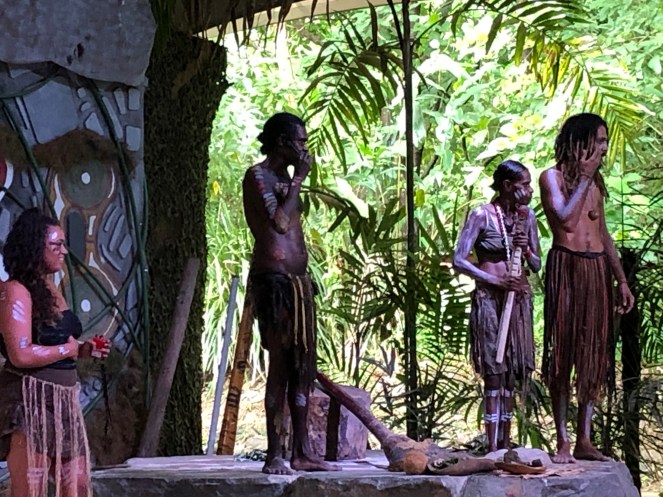
The Tjapukai Aboriginal Center in Cairns, Australia, was established to help preserve and share multiple aspects of the aboriginal culture of the Djabugay Tribe. Located at the foot of the gondolas through the Wet Tropics Rain Forest, it was a fun, educational, and unusual place to visit.

Our first experience was a show with music from the didgeridoo and native dancing, in which we were asked to participate. The dances told stories and represented the animals that the tribe encountered. It was unlike anything I had ever seen or heard, but what struck me the most was what a wonderful sense of humor they had, exhibited in both how they teased us and in some of their dances. Part of the show was a demonstration on how the didgeridoo was made and played. Finally, one of the women explained something of food and medicine preparation and about the strong relationship she had with her grandmother.

From the show we got to try throwing boomerangs. I would starve if I had to catch a bird for my food that way. Finally, we had a presentation of their creation story and their sense of themselves as guardians of the land. Guardians of the land are not unlike our belief in humanity being stewards of creation. From that the stories diverge as their dreamers saw all life coming from a time when all was darkness except for the existence of a giant cassowary egg.

The photo shows some of the performers in the show. To the left of the man in the middle is the didgeridoo lying on the floor. The were wonderful ambassadors of their people.
Wet Tropics Rain Forest, Cairns, Australia

Cairns, Australia is a town about half the size of Lexington, Kentucky, situated on the northeastern coast of Australia in a very unique site. It is the only place in the world where two UNESCO World Heritage Sites meet. In the adjacent mountains is the Wet Tropics Rain Forest and in the sea is the Great Barrier Reef.

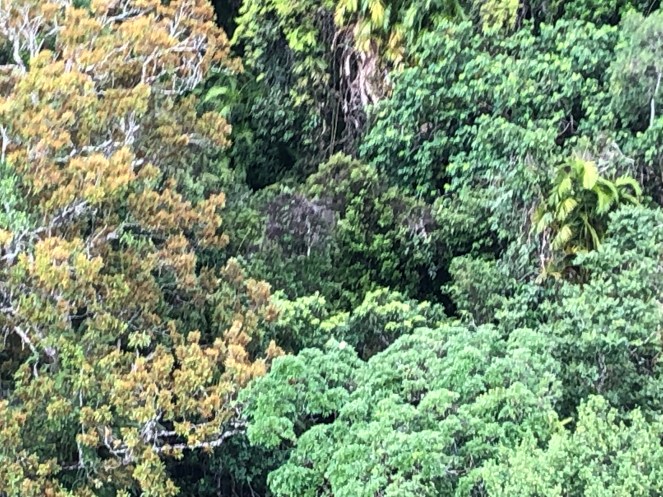
Yesterday, we drove into the rain forest to a small village, called Kuranda. There we boarded gondolas which took us over the top of five miles of rain forest. The second photo of the tops of the trees shows the thickness of the trees and the diversity of plants. The third photo shows what you would expect, rain. The large tree in the middle of the third photo is a Scotch pine that sheds its bark so as to keep vines and other parasites from clinging to it. It is a remarkable feature in the rain forest where most of the trees are covered by other plants, all trying to reach the canopy for sunlight.

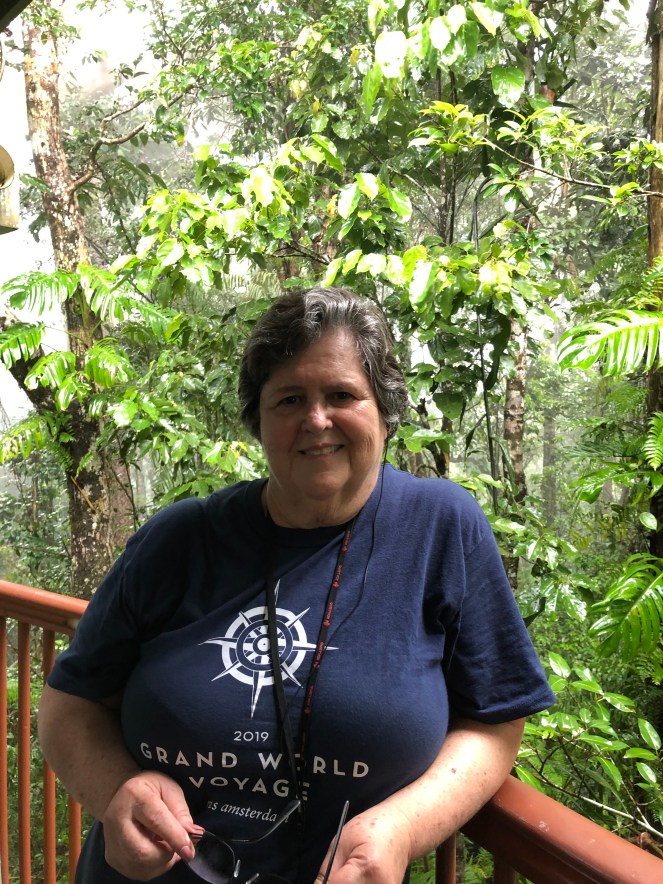
The first photo shows me at the station surrounded by thick trees. I gave our leader, Valerie, an ear worm as we were traveling over the tree tops when I mentioned that Carpenter’s song, Top of the World. I felt like I was “looking down on creation.” Those trees were ancient and unspoiled. It was an amazing experience that took my breath away. Though the origin is not certain, most likely the author of these words is Vicki Corona, “Life is not measured by the breaths you take, but rather life is measured by the moments that take your breath away.”

Great Barrier Reef

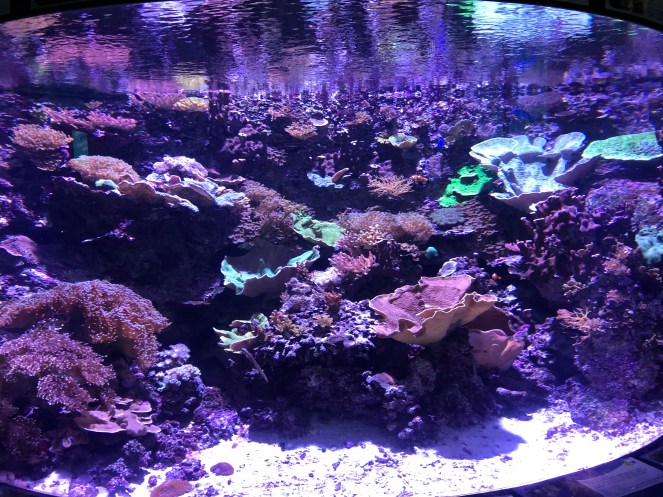
Yesterday, we entered the Great Barrier Reef Marine Park, a UNESCO World Heritage Area. The park is the length of the west coast of America and has 2500 reefs with 3500 different kinds of coral. Coral are living beings that attach themselves to underlying rock. The reef is endangered by a number of environmental factors, the most significant of which is the warming of the sea water. Tourist visits are limited and we did not get to dive or snorkel there; however, these photos are what it looks like. They were taken at the Aquarium in Townsville, Australia, which we visited today.

The Aquarium is constantly studying the health of the reef and working to understand the complexity of the ecosystem. They grow as many coral as possible to allow people to see these amazing sights, however, many types of coral require deeper water and different nutrients from what they can provide.

The Aquarium also operates a turtle hospital which we visited. There, we learned about the dangers of plastic to the turtle population. Once they have eaten enough plastic they begin to float and then die. A study of 50 turtles showed that 100% of the turtles had some plastic in their stomach. Apparently, the turtles can’t tell the difference between jellyfish and clear plastic. I’ve often said our packaging is going to be the end of me, but it may be the end of the turtles, too. Tomorrow, I’m excited to visit the rain forest canopy.

Sydney, Australia

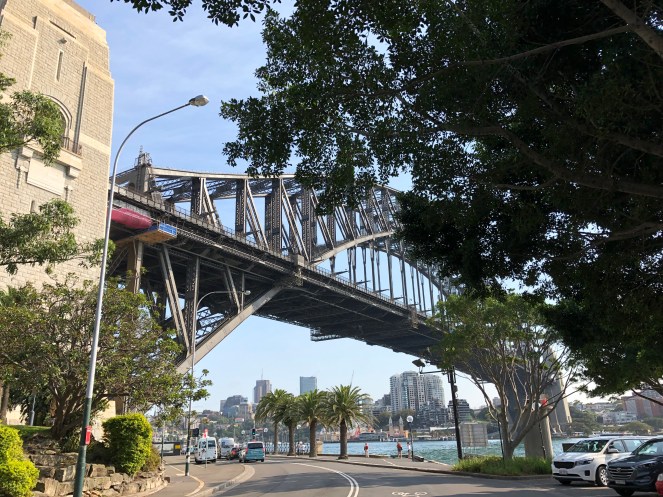
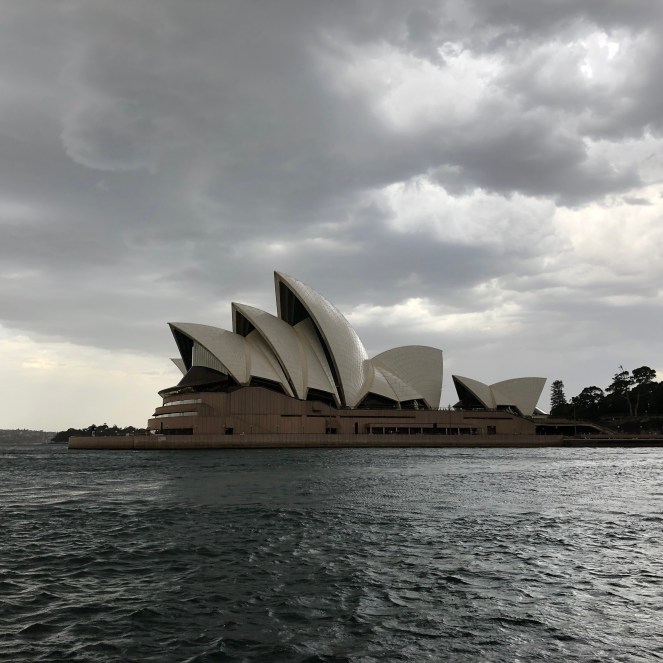
The photo of Harbour Bridge and the first photo of the Opera House were taken from Circular Quay on our first morning in Sydney. Adjacent to this port area is colonial Sydney, an area called the Rocks. The photo of me with the statue of the Scottie dog, Biggles, shows sandstone bricks on both the street and the background buildings. Sydney sits on a bed of sandstone and all the early colonial buildings have this color. I found myself paying attention to which of these structures would have been here when my Dad visited this harbor in 1944. Of course, these colonial buildings would have been as would the Harbour Bridge, which was opened in 1932.

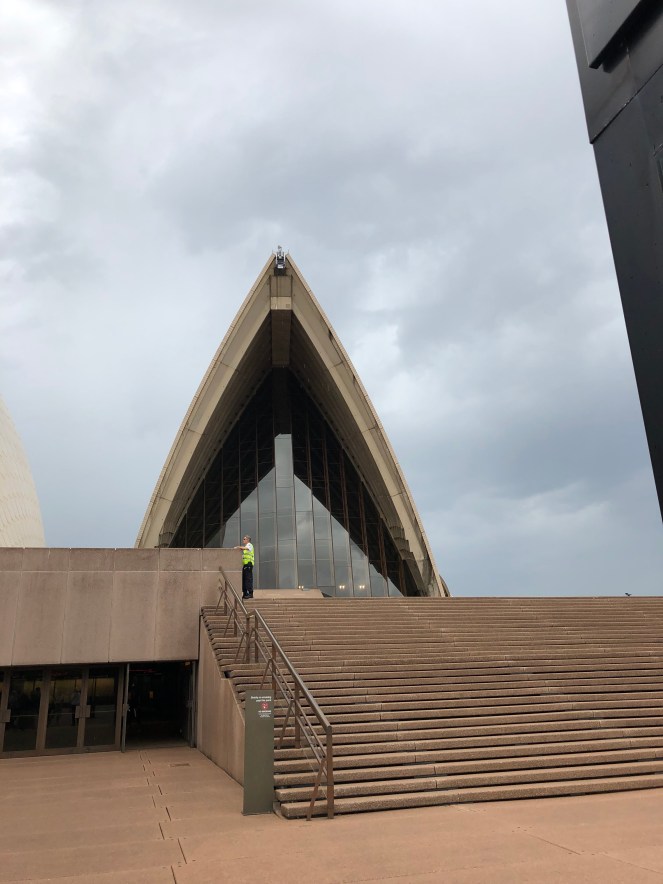
The Opera House was conceived in 1956 and built over the following seventeen years. It is considered the most iconic building of the 20th Century and won the Pritzker Prize for Jorn Utzon, the Danish architect who did the design. The Opera House has five performance venues, the Concert Hall, the Dame Joan Sutherland Theater, the Drama Theater, the Playhouse, and the Studio. Sizes range from seating 150 to over 2500. The Opera House is owned by New South Wales and all the venues are available to anyone to rent. The 4th photo above is the front view of the Joan Sutherland Theatre where Sandy and I heard Turendot and where we are sitting in the last photo. The acoustics were wonderful and we saw and heard a memorable performance.

Sydney did not disappoint. I hope I can come back some day.

I Petted a Python

Today we visited Taronga Zoo in Sydney Australia. The zoo has many animals from all over the world, but we concentrated on Australian animals. They are adorable. This first photo is a koala. He is sitting in the tree in the upper right quadrant of the photo. The other photo is a kangaroo lying in the sun.

We were fortunate enough to have a special presentation by one of the zoo’s animal keepers. He chose to try to diminish our distaste for certain animals. Thus, he showed us a diamond python, a lizard, and a large spider, emphasizing how they were not aggressive and had very beneficial services that they provided for society. For instance, spiders eat 95 percent of the world’s insects. Can you imagine having ninety-five percent more mosquitoes or flies?

The python’s name was Monty. He was about two-thirds of his full size. Paul wrapped him around his neck and carried him around for the group to touch. At first I said “No, thanks,” but when he came by again, I decided that this trip is about stretching myself so I petted him. He was warm (it was a hot day) and he was softer than I expected. I thought he would feel more scaly. Anyway, I survived it and feel rather proud of myself. More on Sydney tomorrow as we have two days at sea coming up.

Sydney Harbor

This morning at 6:24 Sydney time, we passed under the Harbor Bridge and viewed the famous Sydney Opera House behind us. Because my father was here during WW II and talked about it the rest of his life, Sydney has been the place I most wanted to see on this trip. It was worth getting up before five to see the entrance to the harbor.

We have an exciting day planned. First we are visiting The Rocks, an area representative of the original colonial times. We will skip the afternoon trip to the beach to be fresh for tonight when we will be attending a performance of Puccini’s Turendot at the Opera House. It is one thing to tour and view the Opera House and another thing entirely to attend a performance there. I can hardly wait.

Sydney was settled around 1790 when England decided to create a penal colony in Australia. This was necessary because those pesky Americans had rebelled. The first settlers were half prisoners and half guards. It made for interesting early times. More later.

Picton, New Zealand (Aotearoa)

Aotearoa, the Maori name for New Zealand, means land of the long white cloud. This photo, taken from the ship as we traveled down Queen Charlotte Sound from Picton, demonstrates the reason for the name. A perpetual white cloud covers the alpine ridge that runs the length of New Zealand.

Picton, the tiny port where we docked, lies in the Marlborough District, New Zealand’s wine-growing area. We visited Allan Scott Winery, where we had a tasting as well as an explanation of the process for making both plain and sparkling wine.

Before the tasting, we visited the Omaka Aviation Heritage Centre, an aviation museum started by Sir Peter Jackson, the director and producer of the Lord of the Rings movies. Every item is authentic. There are over 25 air planes from the World War I era, most in flying condition. The first planes we saw show the learning curve they went through to figure out how to position guns to protect the plane without damaging themselves. It seems obvious once the problem was solved, but it was not obvious in the beginning. There are examples of uniforms from both sides. They have the remains of the Red Baron’s plane. There are even examples of needlework done by wounded warriors as they filled the time for their recovery. The sentiments confirm their thoughts of home, “Thinking of you,” “For my Dear Father.” This place definitely deserves more time.

Wellington, New Zealand

Wellington, the world’s southern-most national capital, is situated at the southern end of the north island. New Zealand is composed of several islands with the two largest, the north and south islands being separated by the Cook Strait. Wellington, built on hills with a cable car that reminds one of San Francisco, has its city center near the port. A ten minute drive from the city takes you to Zealandia.

Zealandia is an artificially created sanctuary to preserve the native flora and fauna of New Zealand which were decimated by destruction of native habitats and introduction of mammalian predators by the Maoris and the Europeans. The first photo shows a dam and fence that were built to create wetlands and keep mammals out. The second photo shows the fence up in the forest. This fence was carefully researched to keep out jumping, climbing, and burrowing mammals. It surrounds over 500 acres. We entered the sanctuary through a special chamber that had two gates, one of which would not open until the other was closed. As a result of this initiative a number of nearly extinct bird populations are recovering. New Zealand has three such sites.

Back in Wellington after lunch at a very old pub called the Thistle, we visited the government buildings. The executive building a beehive-shaped structure and the House of Parliament were brought to life by a volunteer guide who obviously loved New Zealand, its history, and its government. No cameras were allowed, but we saw the room where the single chamber of parliament meets, the thrones used when royalty visit, the special room designed for the mandatory Maori representation, and statues of prominent people in New Zealand’s history.

Grateful Not Having Seasickness

Often, I take things for granted in spite of my effort to be mindful of my blessings. Tonight, I was reminded of one of those blessings; I have never been seasick. The ship is rolling; waves are so high that the spray comes past our window. It is the kind of night where even the hardiest sailors can be seasick.

During dinner, the ship speaker came on and the cruise director explained that the show at 8 PM would be flautist, Jonathan Johnston. He did the show a few nights ago and is truly excellent, playing a nice variety of classical, opera, show tunes, and pop. The show was supposed to be a group from Australia called The Vallies. They do a singing and dancing tribute to Frankie Valli and the Four Seasons. No explanation was given for the change.

At 8 PM, Jonathan Johnston began his show with “The Toreador Song” from Carmen. He did soundtracks from movies, a medley of American Dixie music, “The Flight of the Bumblebee,” “Danny Boy,” and much more. This gives you an idea of the variety. Why were we blessed with this wonderful music? The Vallies were seasick. Grateful for many blessings, I say good night.

Tauranga, New Zealand

Our shore excursion today was an immersion into the Maori Culture. We visited a Maori meeting house as if we were a visiting tribe. From our men, Harry Fegley was chosen as our chief. He chose a song for us to sing at the appropriate time in the ceremony. We were told that we needed to remove our shoes before entering the house and that women would sit in the rows behind the men.

After these preparations, a young Maori warrior, dressed in typical costume did a rather threatening dance with a spear. At the end he threw a leaf at Chief Harry’s feet. He had to pick it up to indicate that our mission was friendly. Then we entered the house. After a long greeting in the Maori language followed by a song also in Maori, Chief Harry greeted the Maori for us. He told who we were and from where we came. Then we sang “Home on the Range.” The Maori leader obviously knew the song and struggled to keep from laughing at our choice.

Then we all did a Maori greeting which consisted of shaking right hands and touching our nose to their’s while saying “Keori” which is a lot like aloha in Hawaiian. Then their chief explained that the walls were covered with wood carvings done by the men and representing an ancestor. Between the wood carvings were tapestries woven by the women and telling some tribal legend. These alternated on all four walls and together told the tribes story.

Following a question-answer time, we went next door for tea, which was a typical English tea. The New Zealanders were obviously comfortable with both their Maori and their English heritage.