Belfast, Northern Ireland
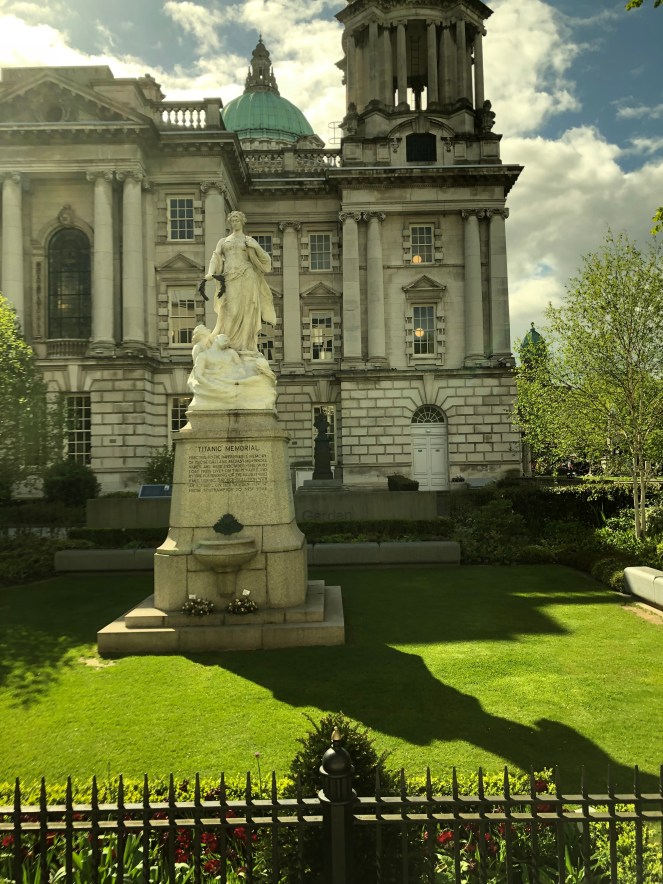
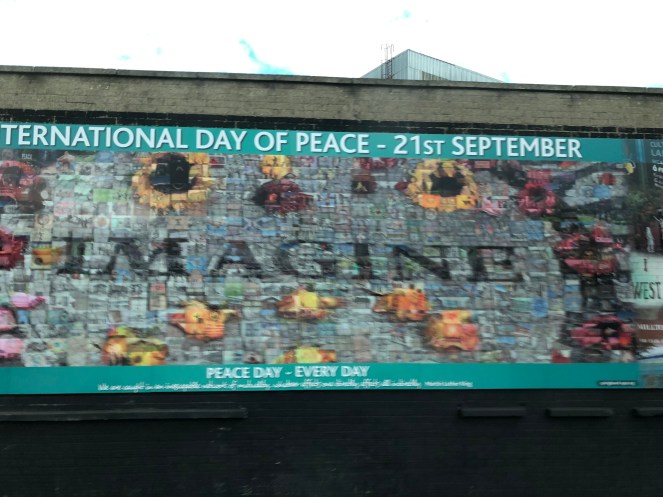
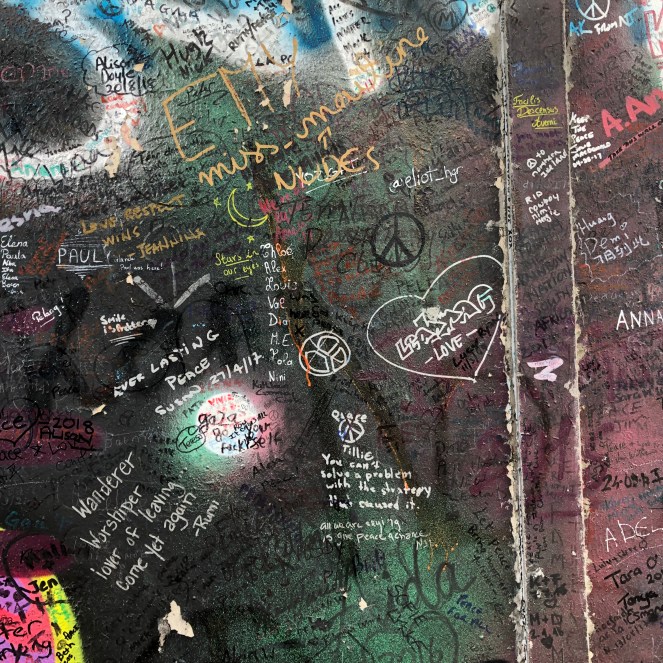
Yesterday on a bus tour of Belfast, our first photo stop was at the memorial to those lost on the Titanic which was built in Belfast. At one point Belfast was a thriving city with prominent shipbuilders, airplane builders, and over fifty percent of the world’s linen production. Beginning in 1970, the city had a terrible decline due to the civil war between the Protestants and the Catholics, the Loyalists and the Unionists. In an amazing one-hour lecture that covered Belfast’s long history, we learned that the battle in Belfast was as much about whether to be a united Ireland or remain part of the United Kingdom as it was about religion. The lecture gave context to the famous murals that we saw later in the city tour.

The first murals were painted on building walls by the Protestant Loyalists, the people that wanted Ireland to remain part of the United Kingdom. Then in 1970, a wall was built around a Catholic neighborhood to help protect it and the Catholic Loyalists had a forum for their paintings and thoughts. It reminded me of the wall the University of Kentucky built around a construction area in the middle of campus that became a forum for students to express unrest about the Vietnam War. This struggle ended in the Good Friday Accords in 1998 and Belfast became a thriving city again.

What we learned from all this is that Ireland may be headed for trouble again if the United Kingdom leaves the European Union. Northern Ireland and Scotland both voted against leaving the EU. If that happens, it will require a border between the Republic of Ireland in the south which is part of the EU and Northern Ireland. When the European Union was formed, this border was abolished. No one wants it back.

Isle of Skye, Scotland

Yesterday, we arrived in Portree, Scotland in tender boats, tossing in the North Sea like fishing floats. There was a question about whether we would be able to visit this port due to the wind and rough seas. Before the day was over, I suspect Captain Jonathan wished we had not. When we were all finally back on the ship, it was over two hours before they could get the tender boats back in place, a dangerous job for the crew in any case but worse in heavy winds. Still, thanks to all of their effort we had a wonderful day.

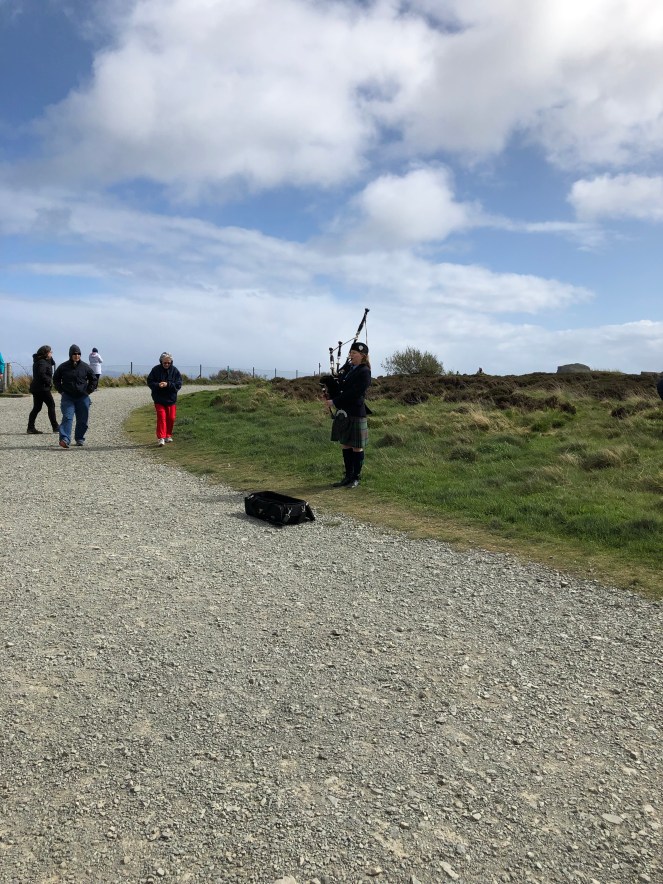
We met at the pier and boarded a bus for a scenic tour of the island. The Isle of Skye, like many of the islands we visited in the Pacific, was created from a volcanic eruption. The mountain and monoliths in the first photo are made of basalt, the black volcanic rock we saw all over the Pacific. We knew we were not in the Pacific when the bagpipes were played at one stop by a waterfall. In the second photo behind the bagpipe player, you can see patches of brown that covered the fields. It was heather, not yet in bloom. You can also see heather next to the yellow gorse in the first photo. Close your eyes and imagine all of this purple, as it will be in August. The last time I was in Scotland, it was blooming. That time on a bus trip through the highlands, I asked our bus driver if a small purple flower I picked by the side of the road was heather. He said “No, that’s a weed.” Feeling really stupid, I asked him to show me heather if we passed some. We drove all the way to the coast and half way back to Edinburg before he suddenly stopped the bus and got off without saying a word. When he got back on the bus, he walked to my seat in the back, handed me this giant bouquet of purple flowers, and said, “This is heather.” I had wanted to see heather on the hill ever since seeing my first stage play, Brigadoon.

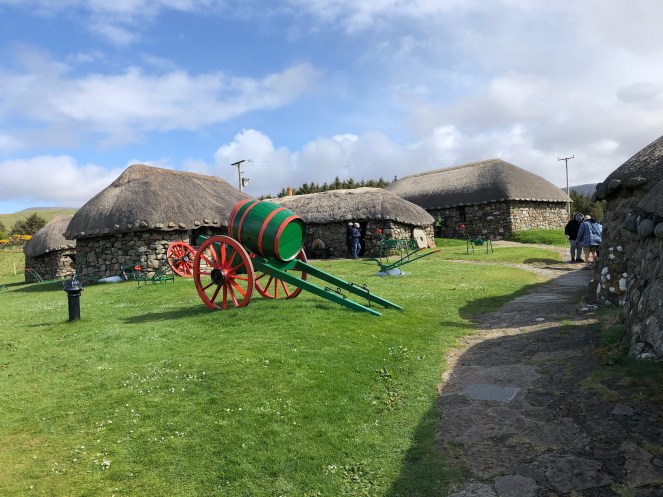
The last photo shows stone buildings with thatched roofs that are all part of the Isle of Skye Museum of Life. When I looked inside these, I was reminded of about every eighteenth century log cabin I have visited in Kentucky. There were the same wrought iron implements, fireplaces, and handmade linens. The difference was that these stone buildings had stone rather than dirt floors and different roofs. As we were leaving this museum it began to hail for about a minute, just enough to remind us how blessed we were with the weather once again. While it was forty degrees and very windy, it was dry as were those curvy, narrow roads.

Flam, Norway

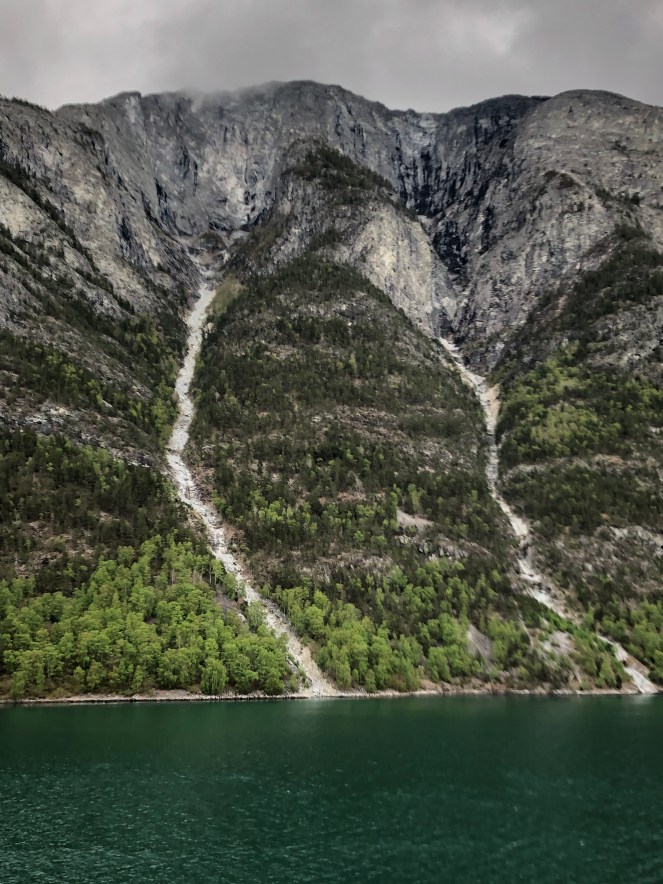
Flam is correctly written with a little o over the a, but I don’t know how to make my keyboard do it, nor am I sure how to say it. What I do know is that it is a beautiful little town at about 61 degrees N latitude, among the fiords on the west coast of Norway and just 3 or 4 degrees short of The Arctic Circle. We traversed three fiords on our way to Flam just after sunrise yesterday and again on our way back to the North Sea about 14 hours later. The first two photos show the same beautiful mountain scene just after sunrise and on our way out. We had a beautiful sunny day around Flam as the clouds only gathered on our way out, blessed again with the weather.

From Flam we took a train ride into the mountains to see the incredible scenery. Norway is known for its fiords, but it could also be known for its waterfalls. The last three photos show just a few. Largest of those we saw, the third photo shows Kjosfossen Waterfall. The names of the others are unknown to me. The train stopped for photos at Kjosfossen Waterfall on its way to Myrdal where other tours are available. We got off in Vatnahalsen for coffee and waffles. The waffles were served with lingonberries, a traditional Scandinavian berry, and they were just as good as the scenery!

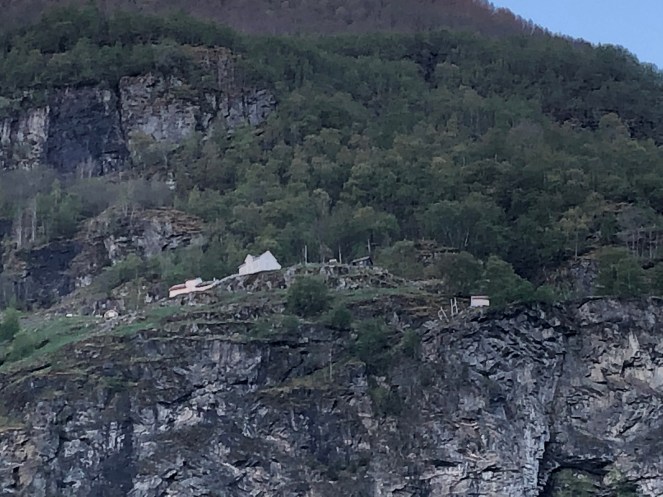
The last photo shows not only two waterfalls but also the starkness of the timberline. We saw this rugged black rock atop all of the mountains except where the higher ones were covered with snow. As we went higher on the train we could also see where the trees were just budding out; at lower levels they were in full bloom. In any season, it would be amazing and beautiful. I may or may not get back here, but I hope some of you will. We passed an AirBNB on the way into Flam perched half way up the mountain, and I thought of Drew who loves AirBNB. It’s the last photo. I am off to the Isle of Skye tomorrow and home two weeks from today.

Copenhagen, Denmark

On Sunday, April 28, we arrived in Copenhagen, Denmark, home of Hans Christian Anderson. Our first photo stop on the city tour was the famous statue of The Little Mermaid. She looks very beautiful and sad. A winged monument to the Danes lost in World War I sits near the mermaid. From there we visited the Royal Palace where the crown prince was in residence. It is a beautiful complex of four identical houses making four sides of an octagon with gates between making the other four sides. A tall fur-capped guard stands at the gate.

From the city we drove along the seashore past the village houses where Danes risked their lives hiding Jewish people during World War II. I had read that only 40 of Denmark’s 7000 Jews died during WW II. A Dane, who worked in a government office during the occupation, warned his Jewish friend who organized an evacuation of all the able-bodied Jews the night before they were to be rounded up. The Germans only found elderly and sick people who were unable to travel when they went to their homes for the round-up. The others crossed the narrow sea that divides Denmark from Sweden, which was not occupied. Denmark was the only country in Europe that protected its Jewish people this way. As we drove along this road, our guide confirmed what I had read.

In the afternoon, we visited Lousiana, a museum of modern art and private collection of paintings by Picasso and others as well as sculptures by Arp, Calder, and Miro’. I’m not a fan of modern art, but I found a number of pieces here, both painting and sculpture, that were very moving. I understand that is the purpose of art. One fun piece was called The Big Blue by Jesus Rafael Soto. From here we went to a fortified castle where a sculpture was hanging from a bridge. It was two arms, like a person had fallen in the moat and was climbing out. You have to love the Danes.

Oslo, Norway

Yesterday in Oslo, we docked within a short walk of the Nobel Center, shown in the first photo, the yellow building beyond the park statue. Inside, the first floor exhibitions are still in progress, but they are meant to inspire everyone of us to do our part for conserving the world’s resources. The second floor is devoted to exhibits about the Nobel Peace Prize winners, which are awarded in Norway at the Town Hall Building next door. The other Nobel Prizes are awarded in Sweden. The second photo is part of a room where each winner is honored. Perhaps, the most affecting exhibit was a tiny room with a book about Alfred Nobel’s life. The story goes that by mistake when his brother died they printed his obituary. It was so unflattering that when he read it, he decided to change his legacy. He wrote a new, holographic will. In it he chose the first five Nobel Prize winners and left the bulk of his vast estate, estimated as equal to 200 million dollars in today’s money, to fund the award for future recipients. His family contested the will for five years but lost in the end.

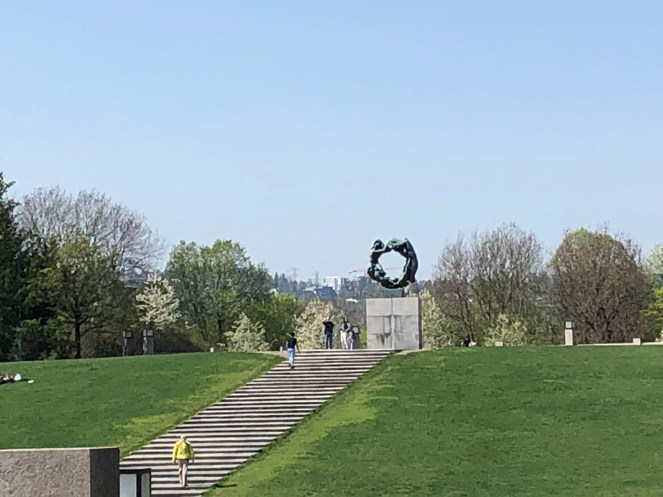
The third photo shows a sculpture representing the circle of life at Vigeland Sculpture Park, the world’s largest sculpture park done by one artist with over 200 sculptures. Gustav Vigeland designed and built the park from 1939 to 1949, finishing casts of all of the sculptures though he died in 1943 before the park was completed. Our guide, who had written a book on the park and used it for a college thesis, said that there were two themes to the sculptures, human relations, especially family relations, and eternity. It was a fascinating place to visit, not just for the sculptures but to see the dozens of people lying in the grass enjoying the flowers and the warm, sunny spring day. Vigeland also designed the Nobel Prize medallion.

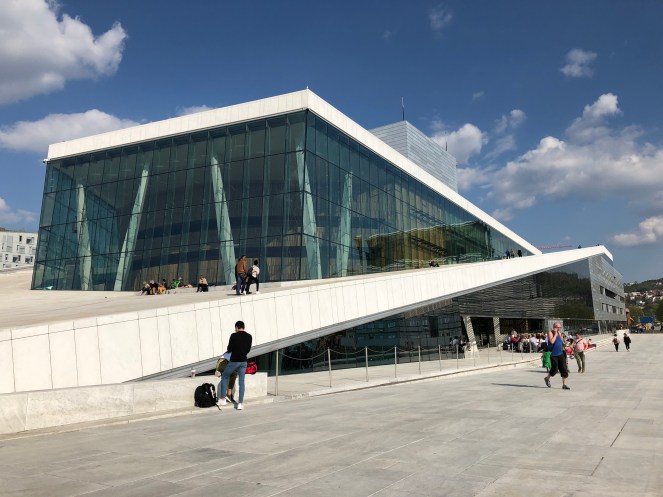
The fourth photo, taken in the Viking Museum, shows a Viking ship that was unearthed in a burial site. Contrary to what I thought, Vikings were buried in the ground in their ships with all of the artifacts they will need on their voyage to the afterlife. This ship was found with two women’s bodies. Most of what is known about the Vikings comes from these sites as they did not leave much in the way of written records. We ended the day at the Oslo Opera House, the last photo. I decided that countries are trying to outdo each other with the architecture of their opera houses. You can walk on the roof to the top of this one!

Amsterdam, The Netherlands

I confess, I was not looking forward to Amsterdam, but I tried to suppress my bad attitude and view the city anew. I am so glad I did. My expectation the first time I came to Amsterdam was to see windmills and dykes. Yesterday, I saw them as the first photo shows. Amsterdam was settled where the Amstel River meets the North Sea. A dam (same thing as a dyke) built in the city center changes the course of the Amstel River and creates water for the extensive system of canals.

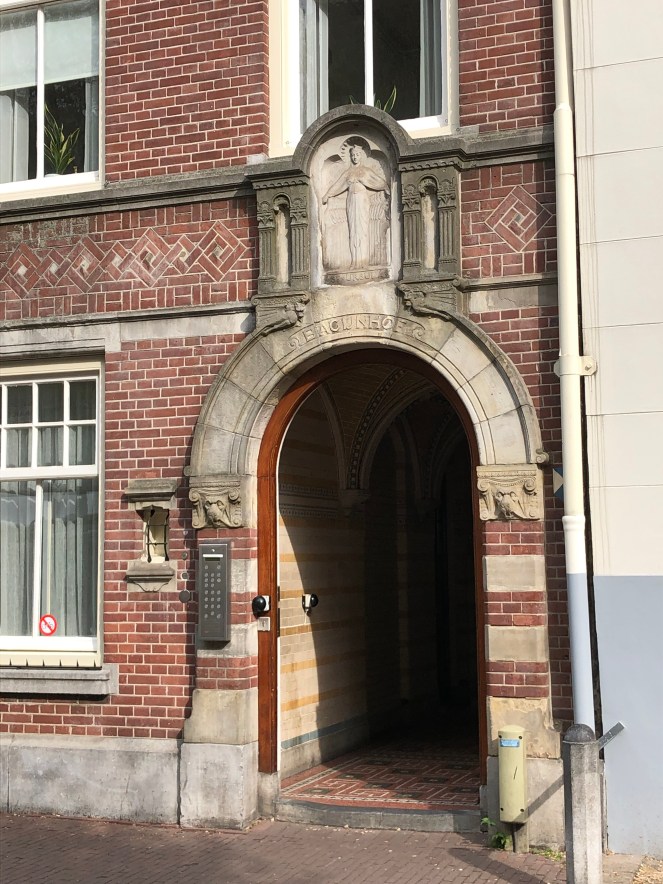
During our walk to the city center we stepped through the arch shown in the second photo and back in time. This place, called Het Begijnhof, is a complex area where devout Catholic women, called Begijens, lived and worked beginning in the fourteenth century. The property contained homes, gardens, and a church (shown in the third photo). From 1578 to 1795 English Protestants were in control and outlawed open Catholic worship. In 1601 the church was given to English Protestants, but two houses were combined and provided a secret place of worship. You could still feel the sanctity of the place.

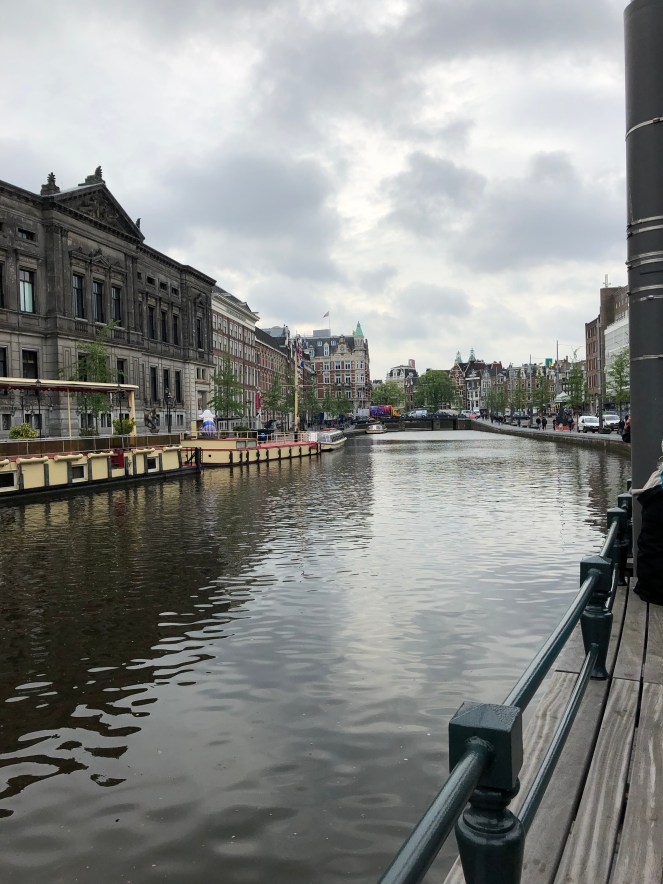
The last two photos, taken during our canal tour, show architecture along the canals and some bridges. We passed beautiful homes in one prosperous neighborhood where Ann Franks’ house could be seen with crowds of people in front. I closed my eyes and saw the tiny room where eight of her family lived from 1940 to 1944 while she wrote her diary. Our guide said that you have to make reservations to see her house months ahead. I was grateful to have seen it on my previous visit to Amsterdam. In the evening, Holland America gave us a private party at the Rijk Museum. I will do a whole post on that later. On Sunday we visit Copenhagen.

Ghent, Belgium

After arriving at the seaport, Zeebrugge, Belgium, we boarded a bus for an hour trip to Ghent, a settlement present at the confluence of the Schelde and Leie Rivers since the Middle Ages. In 1300, Ghent had 50,000 people and was one of the richest cities in northern Europe. The first photo shows the old guild halls along the left of the canal and St. Michael’s Bridge in the distance. Along with the two rivers, the city has an old system of canals that have been designated a UNESCO world heritage site. Most of our time in Ghent was spent seeing the sites along these canals, one of which was the Benedictine monastery, shown in the second photo. Here were the beginnings of the Inquisition. The austere building and the grey sky seem fitting.

Though it was a cloudy day, we had no rain until after lunch. In the afternoon, our open canal boat took us to our buses in rain. The umbrellas they provided made a colorful canopy over the boat but failed to keep us dry; our heads and shoulders were dry, but each of our umbrellas dumped water onto the lap of the passenger seated beside us.

One of the things I love about Europeans is their love of flowers. Flower boxes decorate the balconies. Flower shops are present on every corner and you see people buying bouquets to take home. Every cafe has fresh flowers on the table. The flowers on the ship are stunning. The last photo shows a close up of pansies in boxes along the canal in Ghent. Raindrops on colorful pansy leaves made that wet lap worth it.

Normandy, France

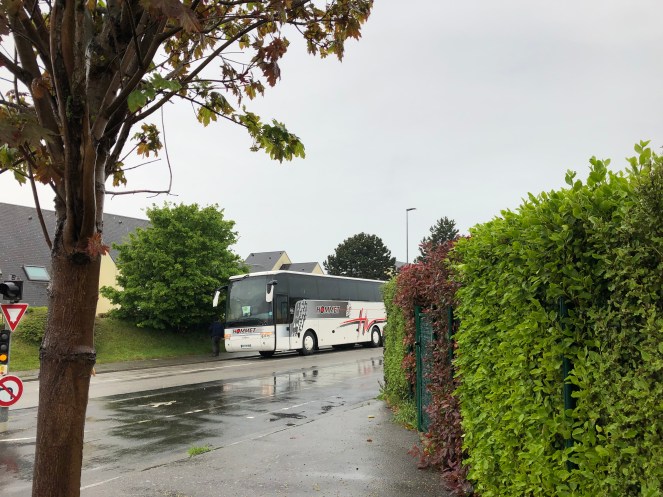
After arriving in Cherbourg this morning, we set off in a coach for Utah Beach and Bayeaux. The coach stopped at a stop light and I mean stopped. A technician came and said we needed a new coach. Half of us went to a nearby pub and had coffees, Irish and otherwise. On a new bus, we proceeded through the beautiful, Normandy countryside, past canola fields in yellow bloom, fields full of cows, and fields of apple trees. Along the way unevenness of the land from bomb craters and abandoned German bunkers could be seen. The area is known for its Camembert cheese and its hard cider.

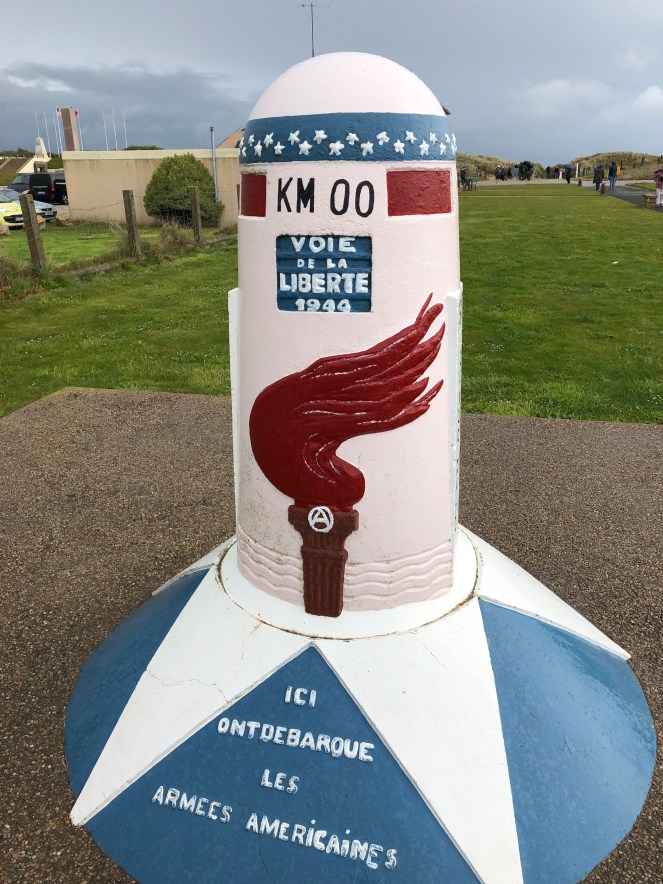
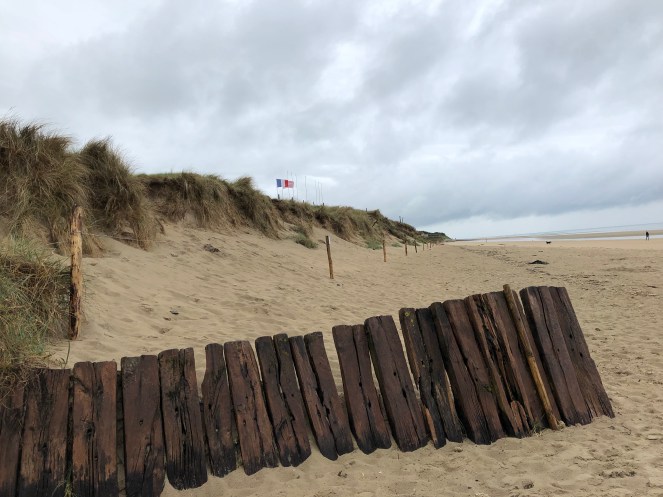
At Utah Beach we saw in the distance the cliffs that divide Utah Beach from Omaha Beach. On the beach we also saw two small islands in the English Channel that were the first areas to be approached. Multiple monuments and a museum are scattered around the approach to the beach. Our guide said there are over 90 war museums in Normandy. One of the most interesting monuments was the Way of Liberty, Voie de la Liberte, 1944. The first of 1147 monuments like this is placed at Utah Beach. Another is placed every kilometer from the landing site at Utah Beach to the site of the decisive Battle of the Bulge in Belgium. Everywhere around the beach we saw the American flag flying beside the French flag as in the beach photo above.

Our delay meant that we did not visit one of the cemeteries. There are now two American and eight German Cemeteries as well as some for the United Kingdom, New Zealand, Canada, and Australia. Some that were previously American are now German as 60 percent of the Americans have been brought home. In the afternoon, we visited Bayeux and saw the famous Bayeux tapestry that shows the build up to and the details of the Battle of Hastings. The tapestry, now over a thousand years old, was commissioned by William the Conqueror to tell the story of his conquest to people who were illiterate. The tapestry is 47 meters long and made of linen. This was of some interest to me as the Purcells came to England and Ireland with William the Conqueror, the source of my Scandinavian genes. Tomorrow, Sandy and I are off to Ghent, Belgium.

Earth Day in Porto, Portugal

Reports claim that Porto, Portugal is one of Europe’s most beautiful cities. Located on the Douro River just before it opens into the Atlantic Ocean, the earliest settlement here is believed to date back to 500 BC. The Romans built walls that still mark the old town which is a UNESCO World Heritage Site. The central square, shown in the first photo, is still the site where the people get together for celebrations and parades. The city is built on two hills and this square is between them. The second and third photos show the hills to the east and west of the central square.

One particularly beautiful building is the Train Station, shown in the fourth photo. The walls are covered with scenes done in blue and white tiles. The fifth photo shows the details of one of the scenes. Our guide explained that the squares were painted and numbered so the final picture would be made. Around the top in other colors, the scenes depict the history of transportation. As always the photos fail to show how incredibly beautiful this was.

Porto is said to be the site of the origin of port wine. Our last stop today was to the Ferreira winery where white, red, and tawny port wine are made. This was on the south side of the river. The last photo shows the old town from across the river with the winery’s boat in the foreground. The grapes are grown in the Douro Valley and brought to the winery on boats like this. We learned that port is different from regular wine because the fermentation is stopped after just a few days by adding brandy. This makes port sweeter and fortified, twenty percent alcohol compared to twelve. It was fitting that we should be here on Earth Day. Throughout the city we saw garbage bins in groups of four with different colored labels so that recycling would be easy, the first time we have seen this. No doubt, this is a beautiful city and warrants further visits.

Easter in Lisbon, Portugal

Without being in my home church and with my family, this was about as perfect as an Easter Sunday could be. We started with sunrise service at 6:30 AM on Lido Deck by the pool, which sounded like ocean. The choir sang He Arose and during the singing of He is Lord, the sun came up. Shortly after church, we arrived in Lisbon moving up the River Tagus and passing by the Christ the Redeemer monument, modeled after the famous statue of Christ in Rio de Janeiro. This monument was created to commemorate Portugal’s neutrality during World War II.

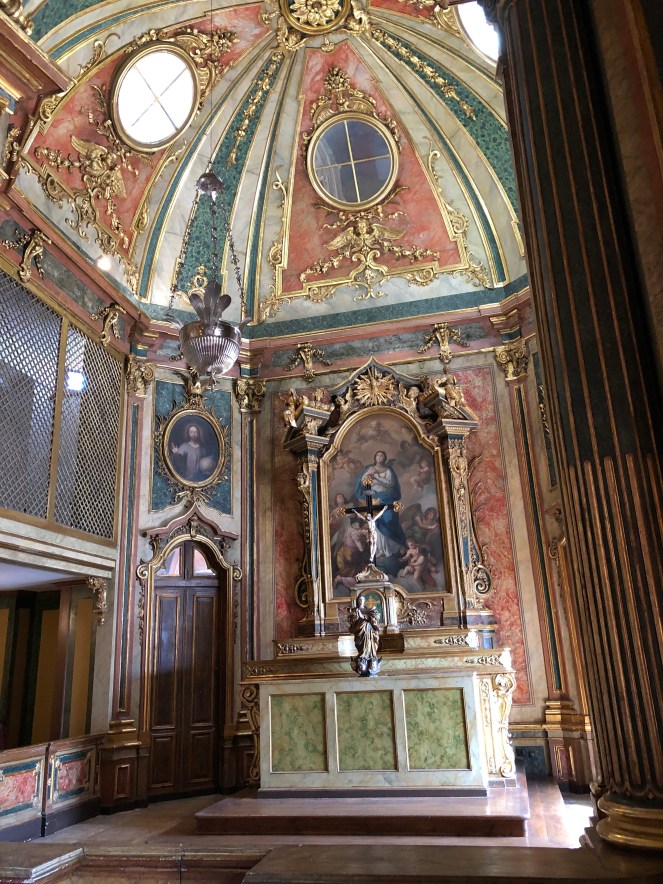
During the morning, we visited the National Palace of Queluz, shown in the fourth photo. This was the summer home of Portuguese royalty, modeled after the palace at Versailles with baroque and rococo features in the decor and furnishings. The chapel and the Murano glass chandelier, shown in the fifth and sixth photos, were two of my favorite parts of this beautiful structure.

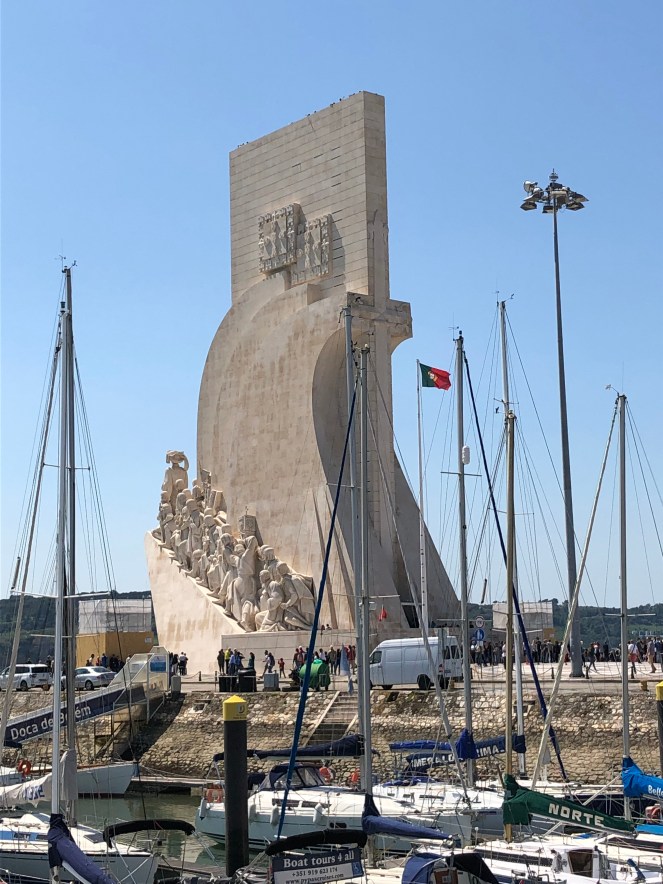
From the palace we drove by several of Lisbon’s important buildings and monuments. We saw the cathedral and the monastery next door but were not able to enter due to services for Easter. The last photo shows a monument to honor Portuguese explorers, called the Monument to the Discoverers. It shows Prince Henry standing in front with thirty-three others on the steps. The monument features only one woman, Prince Henry’s mother. In the afternoon, while some other Road Scholars walked around the old district, I took a nap, my favorite Sunday afternoon activity. I awoke in time for the scenic sail away in perfect weather, ending the near perfect day. Happy Easter, Christ is risen, indeed.