Auckland, New Zealand
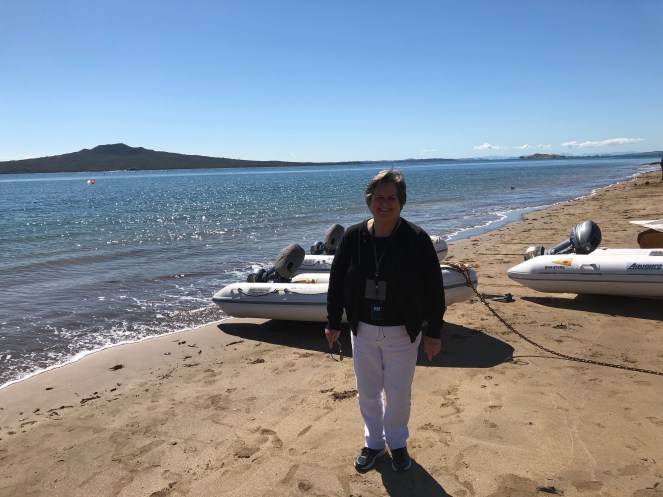
We arrived this morning to a beautiful, sunny day in Auckland, New Zealand. Behind me in this photograph you can see several of the 47 volcanoes that fill the water around the port. They look like tiny islands rising out of the sea. New Zealand sits on the meeting of two tectonic plates and is home to multiple earthquakes and volcanoes, though the last volcanic eruption was 600 years ago.

Below is an example of a 75 year old kauri tree which is really just a baby. These trees live to 1600 years of age and are the source of the sticky resin that traps insects and then hardens to make amber. This sample is in Eden Garden, a small garden filled with a vast variety of plants. They are extremely slow growing and were widely cut by the Maori when they first came to New Zealand about 800 years ago. At that point they did not realize how long it took them to reach the enormous size they finally reach. They are carefully protected now.

After lunch at Eden Garden, we visited the War Memorial Museum which was built by two architect brothers returning from World War I. In the museum we saw beautiful example of Maori canoes, meeting houses, storage huts, tools, and carvings. The ship was to leave at 4:15 PM so we had to pass on the more modern exhibits. Auckland definitely fits in the category of places that need to be revisited.

Tonga

Tonga, pronounced Tong-a, not Ton-ga, was the site of our travels today. This colorful photograph is our tour guide, Lava, standing in front of the royal palace. The Tongans seem very proud of their monarchy, which began in about 1867 and instituted many personal freedoms that were not given the people by previous dictators.

Tonga is a Christian nation, first introduced to Christianity by the Wesleyans. They have multiple denominations now, but all agree that everything should be closed on Sunday and the Sabbath made a day of worship. Today was Saturday; I’m not sure what would have happened if we had arrived tomorrow.

Tonga is different from all the other islands we have visited so far in that the central volcanic mountain is missing. Tonga is flat and surrounded by a coral reef. We visited a stone carving that dates to 1200 BC and seems to be a Stone Henge type structure. Markings on the stone coincide with the equinoxes. We were blessed with perfect weather, about 80 degrees and a pleasant breeze.

Crossing the International Date Line

I will never in my life have lived February 20, 2019. That was the date the ship chose for us to lose. We crossed the International Date Line and had to move our clocks forward a whole 24 hours. That meant I missed Wednesday all together. If you think about it, you realize that in some way you have to make up for those 25-hour days that I talked about a few days ago.

We don’t really lose that day; we just add the time to the days one hour each day as we move west. If you go back and forth you lose it and gain it back, but since we go all the way around in one direction, we only gain it back in pieces.

The International Date Line is an imaginary line that is drawn at approximately 180 degrees from the prime meridian that passes through Greenwich, England. It separates the globe into western and eastern hemispheres with the date in the eastern hemisphere one day ahead of the west. It passes through a largely unpopulated part of the Pacific and is deviated east or west in places to accommodate populated areas. The ship gave us a certificate signifying our passage which occurred between Bora Bora and Tonga.

Bora Bora

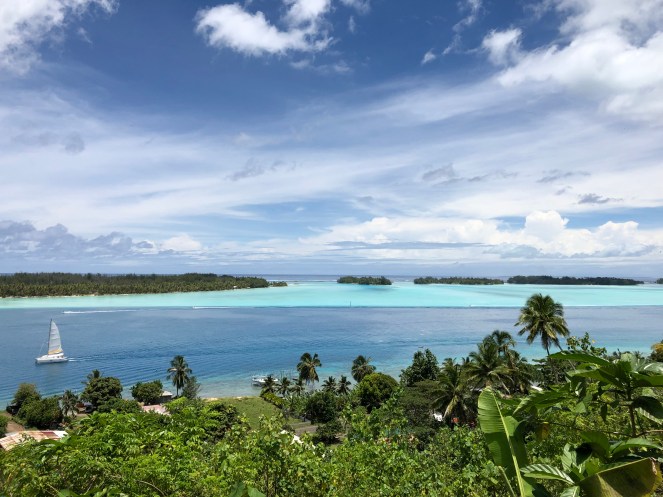
Ah, Bora Bora. This is by far the most beautiful place we have visited. There is no way my photographs can catch the multiple blues. Tahiti was magical, exotic, modern, and developed. Bora Bora is beautiful, wild, and fun. Our guides and drivers today were young, relaxed and laughing, even though they drove us up some of the steepest and roughest terrain I have ever navigated. Their goal was to give us views that would take our breath away and they did.

Bora Bora was an American military base during WWII because of its natural features. There is one bay where our ship anchored with one narrow way into the bay. The rest of the island is surrounded by a lagoon and coral reefs, which are inaccessible. The American battleships were anchored right where our ship is now. Eight guns were placed around the island to protect the shipping lanes that supplied the Americans in New Zealand and Australia. We visited the remains of one gun site. The Japanese never arrived here so this would not have been a bad place to spend the war.

We visited a beach so I got to get my feet wet in the Pacific. The mountain tops are very distinctive here with the square rock to the right of the peak from the ship’s view. I made a video of our guides and drivers singing and playing ukuleles. I wish I could upload it just because it captures the pure joy of this place. When I get home, ask me to see it. In the meantime, I loved Tahiti, but I left my heart in Bora Bora.

Tahiti-Island of Dreams

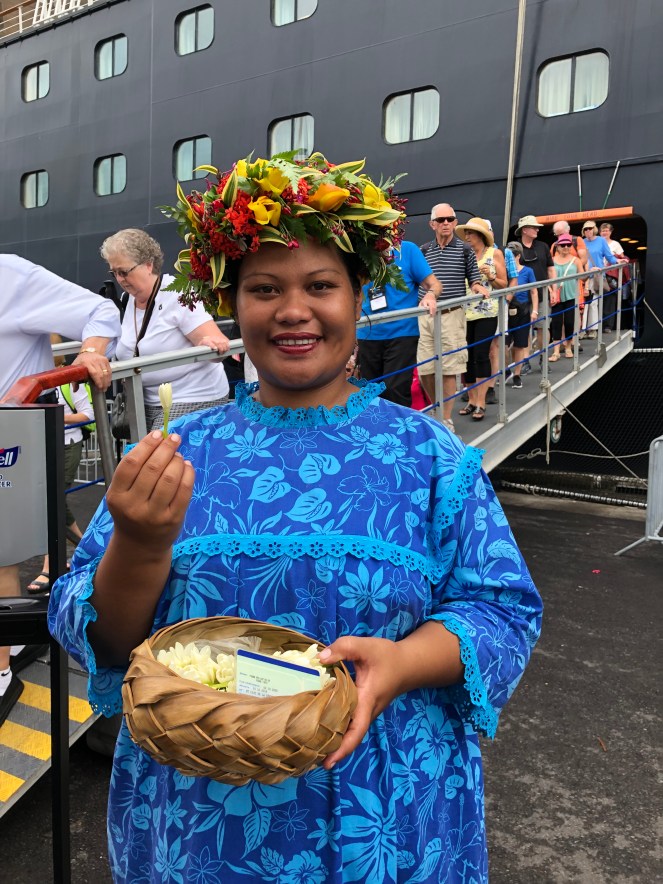
Tahiti, exotic and magical, has been the place I would have gone, if I had been the sort who ran away from home. Gardenias have been my favorite flower since I went to Evie Davis’ wedding during medical school. When I set foot on Tahiti this morning at 8:00 AM, I was given a gardenia blossom by the beautiful woman in this photo. As we boarded the bus, we were given a whole lei of Tahitian gardenias. I was in heaven with that fragrance around my neck all day!

We traveled around the whole island, about seventy-five miles, with multiple stops to see the sights. First we visited a marae, a religious site where the chiefs were celebrated at birth and death and humans were sacrificed before they went to war. From there we went to a beautiful garden next door and similar to Paul Gauguin’s garden, which was closed for renovations as was the Gauguin museum. The garden had a waterfall, lily ponds and a wedding party dressed in traditional Tahitian garb taking photos. From there we visited a larger waterfall in a tropical rain storm. I got soaked but did not care.

We ate typical Tahitian food for lunch on a lovely ocean-side estate and then visited a blow hole. This is a place where the ocean waves go into a lava tube and are trapped. The water pressure builds up and the water is released like a geyser from a hole in the surface separate from where the water enters. From this interesting geological formation we went to Point Venus, the site of Captain Cook’s arrival as well as that of the Bounty. An old light house is on that spot and two wind surfers were playing in the bay. This if the first place where I definitely want to return. Color me happy!

25 Hour Days

The fall time change that gives us a twenty-five hour day has been one of my favorite days, but one can have too much of even a good thing. Since we left Chile on February 4th, just ten days ago, we have set the clock back an hour six of the ten days. Sandy and I were both awake at three this morning, feeling like it was seven and hearing people walking around in the rooms above us. Still this beats setting it forward six of ten days. I suspect that these cruises always travel west to avoid that, but I will have to research that!

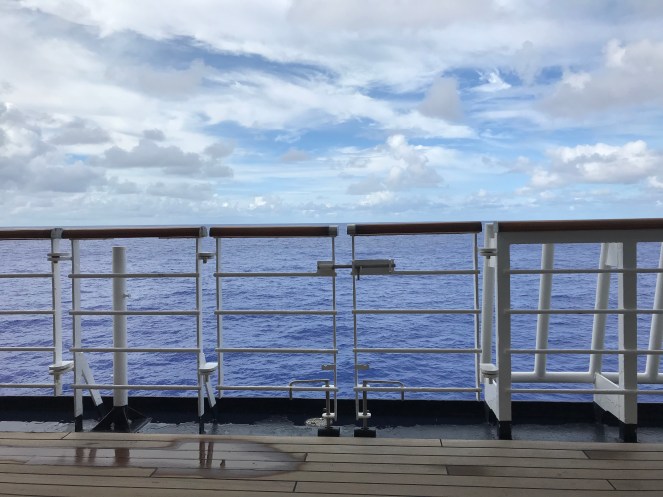
My cold is better today but I still have a productive cough, so I am sitting in a deck chair on the lower promenade deck letting the ocean breeze carry my germs out to sea. I don’t love the cold, but I do love this. The sound of the ocean is like God-given background music. I have loved that sound since I first heard it at seventeen years of age. The temperature feels about seventy-five degrees.

It is my firmest belief that God can and does redeem every bad thing that we do, that happens to us, and that happens to those we love. We don’t always recognize it, but we will see it some day. I have been on this ship twenty-three days, and this is the first time I have taken the time to just sit here and enjoy the warmth and the sound of the ocean. I might never have done it in the busyness were it not for the cold. This view from my deck chair will be the same all day.

Pitcairn Island

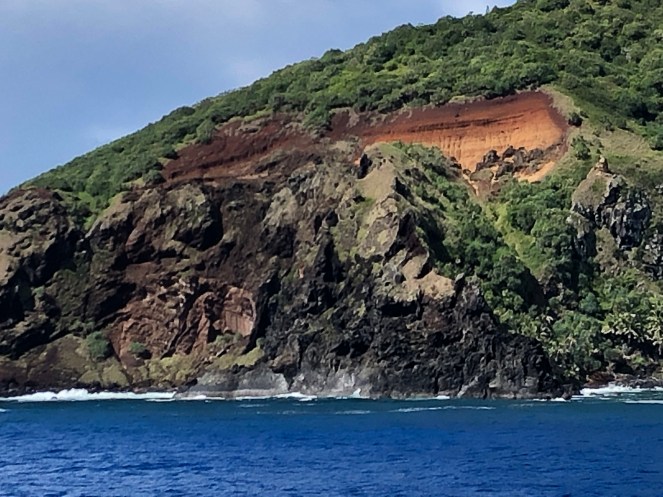
We arrived off Pitcairn Island this morning. Pitcairn has a population of about 55, many of whom are descended from Fletcher Christian, the infamous leader of the mutiny on the Bounty. The rugged shore, as you can see in this photo, does not lend itself to landing, part of the appeal for the mutineers. The Bounty lies at the bottom of the sea in front of this shore.
About half of the population came on board the ship to sell handmade items, stamps, postcards and to stamp our passports, but we were not permitted ashore.

I wore a mask to take some photos but spent the rest of the day in my room suffering from a cold. I chose not to give my cold to a whole island. Hopefully, by the time we reach Tahiti it will be gone.

Rapa Nui Photos

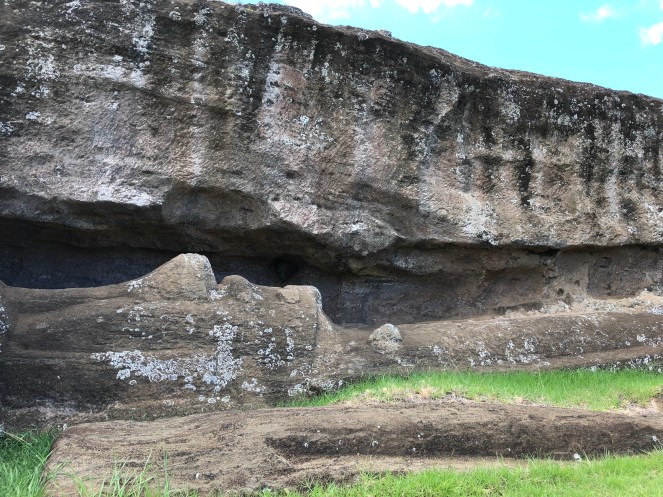
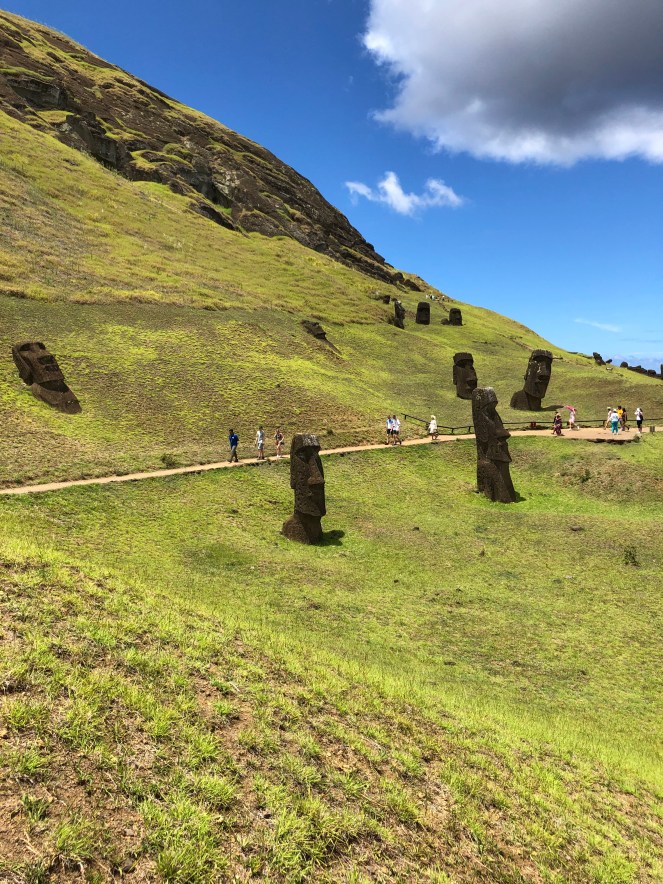
Having been to this UNESCO world heritage site thirty years ago, Sandy said that at that time only three or four of the Moai were standing. The others were lying down in place, like some in the second photo.

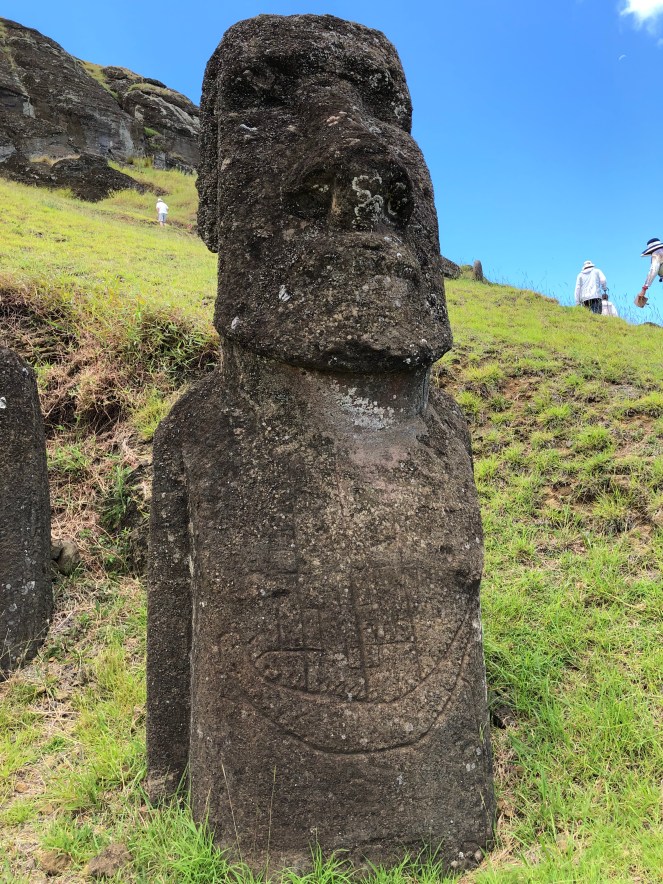
The third photo shows a close-up of one of the Moai. The statues are black as you would expect from volcanic rock, but a few have a red cap. We saw only one of those in the long line of Moai. The statues were carved out of a lava flow. The first photo shows one in place, being carved out of the surrounding walls.

We learned that a number of people were not able to get off the ship on Easter Island, and we feel very fortunate to have seen this amazing place. At sea for the next five days, I will be learning bridge and singing. The music is challenging, but it is fun to learn it. Unfortunately, two sopranos quit today, making our already small section smaller.


Rapa Nui-Easter Island

Rapa Nui is the Polynesian name for what we call Easter Island. It is said to be the most isolated single inhabited island in the world. It lies 2000 miles from Chile and over a thousand miles from Pitcairn Island, our next destination. It was formed from volcanic eruptions and still has three main active volcanoes. It is home to about 7500 people, which is 2500 more than the island can sustain. We arrived early this morning and had to wait until almost 1 PM before it was safe to board the tender boats that took us ashore. The boats were rolling up and down in the swell and the Captain repositioned the ship three times.

Our tour which was to take all day was condensed into half a day. The guide told us that only 8 to 10 cruise ships are allowed to visit the island in a year. The tiny port is surrounded by rocks so all the transports have to be done in daylight.

Rapa Nui is known for its Moai, large statues carved from volcanic rock between 900 to 1200 AD. They are said to honor the ancestors of the first clans of Polynesian people who inhabited the island. Many were lying down or buried until restoration to their original position in the last thirty years. The Moai in the row behind us in the photo were discovered and restored after an earthquake in 1992. We had a perfect day to visit them and were blessed to be able to get ashore, safely.

A New Understanding of Big

In preparation for this trip, I read that the Pacific Ocean covered one-third of the earth’s surface. That’s big. We’ve been at sea for five days with another day to go before we reach Easter Island, our next stop. Easter Island, a tiny volcanic island, is about half of the distance between the west coast of South America and French Polynesia, which is only about half of the way to Australia at this latitude. Seeing nothing but ocean and one school of dolphins for five days gives big a whole new meaning.

We are even between two satellite feeds, so I can’t upload photos. Thankfully, text still works. Today, I had my first chorale rehearsal. We worked on Bohemian Rhapsody. One of the women said, “I did not expect it would be so hard.” My response was “I did expect it to be hard, and it is.” The rhythms are tricky, the tempo quick, and the words crisp. To help me learn it, I tried to find it on the internet tonight and after waiting hours, it still did not download. I will try again when we get closer to land or on a different satellite. Our performance is at the end of the trip.

I start the days at sea with a walk and the morning stretch class. My bridge lessons continue each day at sea at 9:30 AM, and I practice with my fellow beginners in the afternoons. I hope the bridge group at church will let me play when I get home! In addition to learning bridge, I plan to help one of our Road Scholar group teach Mah Jongg. At least six of the group have expressed a desire to learn. Sandy and I learned last night that there is a performance of Turandot at the Sydney Opera House on the evening we are docked overnight in Australia. We bought the last two tickets, so now not only do we get to see this amazing structure, we get to hear it’s acoustics. Wonderful things continue for this country girl. Thanks, everyone for your interest and comments.