Abortion

When I wrote Saving Jane Doe, I wanted to show the complexities of the abortion issue, to show the horrible things that could happen and the multitude of reasons why women would consider that option. Knowing that I would be asked questions about the abortion issue as I promoted the book, I read the majority and minority opinions in the Roe v Wade Supreme Court case. I was impressed by how thoroughly the justices had considered the issue. They observed that making abortion illegal did not prevent it. The largest number of abortions done in the US was during the 1930s. Women chose to be aborted, when they could not feed the children they already had. They observed that making abortion illegal made a disproportionate hardship on poor women. They observed that abortion has been part of every culture throughout history. They looked at the medical facts. It is more risk to a woman’s life to carry a pregnancy to term than it is to have an abortion before fourteen weeks of gestation. They did not consider that the government had a right to require a woman do something to risk her life if she chose not to. The justices also considered the fetus. Roe v Wade is the first case to give a fetus legal rights. The justices plainly state that a fetus has a right to life at viability. In 1973, they determined viability to be twenty- seven weeks. Thus, third trimester abortions were banned.

I also read the majority and minority opinions in the case that reversed Roe v Wade. I wish I could tell you clearly the reasoning used, but I cannot. It was unclear what if anything had been considered. It seemed a lot of rambling to justify a preconceived plan.

Abortion is a complex issue that involves two people. Roe v Wade recognized that and considered both people’s right. The reversal clearly did not. The issue is not about what is right and wrong. It is about what the government has a right to do. Nobody likes abortion. I believe that most people think it is morally wrong, but it is not the business of government to legislate morality. Do not take my word for it. Read the majority opinions yourself. Then, whatever your opinion is on the issue, it will be better informed.
Celebrate Easter

Yesterday, I felt sad. As I reflect on it, I think missing church this Easter Sunday will be the hardest thing I have experienced so far in this unprecedented time. I will miss the glorious anthem our choir sings. I will miss the beauty of the sanctuary, filled with spring flowers. I will miss the wonderful congregational singing at my church, Liberty Road Faith Fellowship. I will attend the service, live on Facebook, beginning at 10:45 AM, but it won’t be the same as sitting in the choir loft and looking out at the church full of worshiping people.

But further reflection reminds me that I love Easter Sunday for reasons that are just as true this year as in the last two thousand years. Christ is risen. He is risen indeed. That is why we celebrate. That is why we have hope in these dark times. That is why we know there is light, not just at the end of this dark tunnel, but at the end of our days. God is, was, and will continue to be in control. That gives me comfort when I feel helpless.

So, I will celebrate Easter, watching church on my computer, but most importantly, worshiping God. I will take a walk in the beautiful world He created. I will thank Him for all the people who are putting themselves in harm’s way to care for the sick. I will thank Him for providing all that I need, including my no-sew mask which is washable. May you know joy and peace as you celebrate Easter.

Make Your Own No-Sew Mask

When I first learned that the Covid 19 virus was spread by infected people before symptoms occurred, I predicted to myself that everyone would be required to wear a mask in public before this pandemic was over. Yesterday, the CDC made that recommendation and we all should abide by it. So, I wondered when I made my prediction, where are we going to get 300 million masks, not counting the millions used by personnel caring for sick patients. I started looking into patterns and materials to make my own. When my sewing machine broke while sewing the first mask, I came up with a no-sew version.

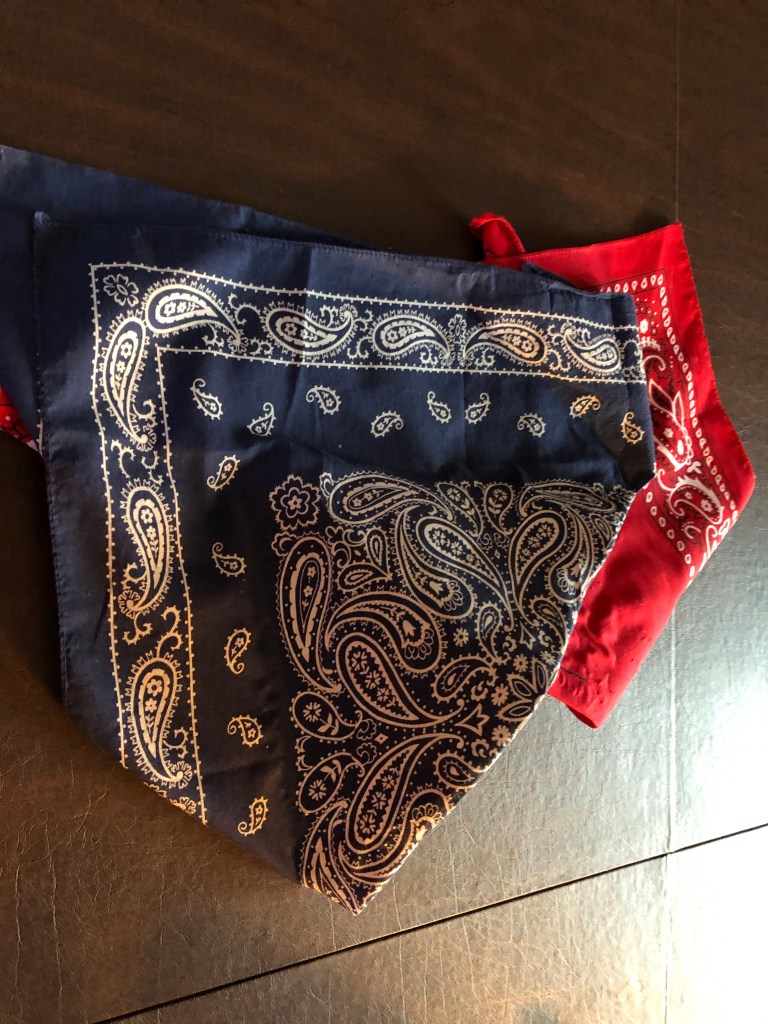
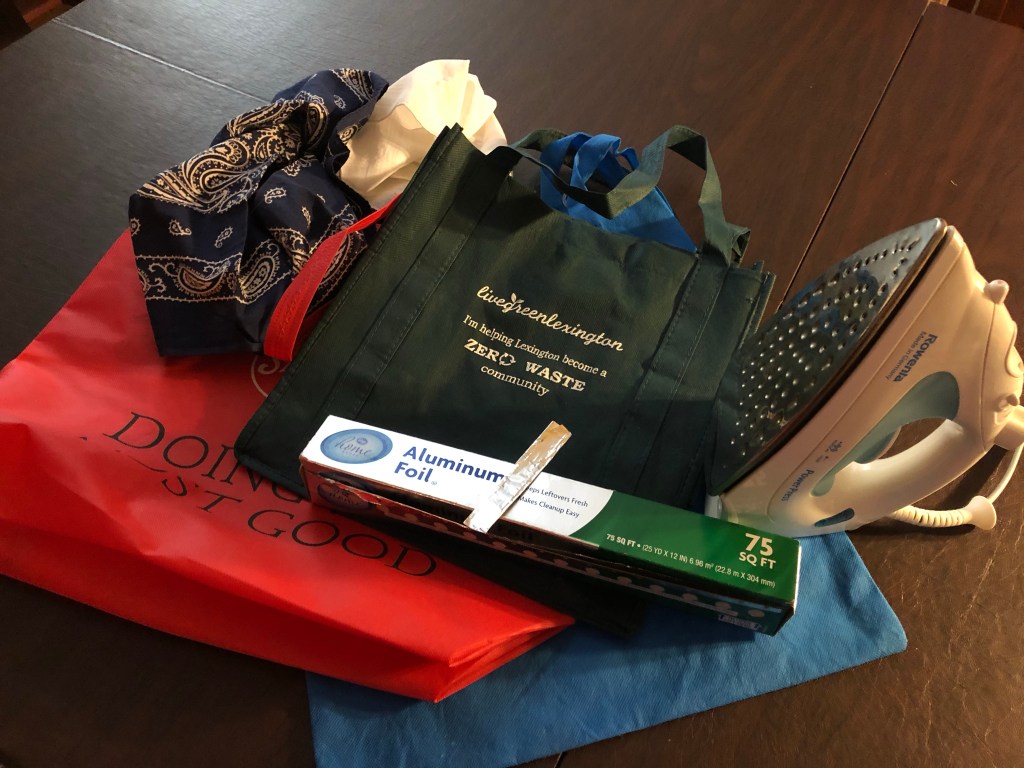
N 95 masks are impermeable, fitted to the face, and certified. This mask is impermeable, fitted across the nose, and obviously not certified. I want to thank Cindi Rein, who owns The Fabric Patch, a quilting store in Washington State, for her excellent video on making a woven fabric impermeable by adding a non-woven, bonded fabric, such as the material in fabric, recycling bags. For these no-sew masks you need a square piece of fabric, such as a bandana or large handkerchief, a square cut from a recycling bag, a piece of aluminum foil, and an iron.

Materials

First, measure from ear to ear across your nose. Next cut a square of the bag with the diagonal the size of your measurement. Tear off a ten inch piece of aluminum foil and roll it to make a half inch wide flat piece. Cut this about four inches and fold it in half, along the long dimension. Next lay your bandana wrong side up. Place the square from the bag in the middle of the bandana and fold the square in half into a triangle. Next put the aluminum foil in the middle of the fold of the bag material.

Assembly Position

Next you fold the bandana over the triangle formed by the bag material. Now, being careful to keep the bag material at the fold in the bandana, you iron both sides of the bandana on high heat which causes the bag material to bond to the bandana. The final product looks like a bandana, but you are breathing through two layers of water resistant fabric as well as the cotton and you can pinch the aluminum foil to seal the top of your nose. While it isn’t fitted to your face, the impermeable material does extend over your nose and mouth.

Finished Product

Stay safe out there and please wear a mask. Make your own even without a sewing machine. The sewed version of masks with this material is washable, but I don’t know about this one. I will have to check and write more about that later.

A New Bucket Listing

On Saturday afternoon, Sandy and I went to the William Howard Taft National Historic Site in Cincinnati. This is the birthplace and boyhood home of Taft, the twenty-seventh president of the United States and the only president to also be Chief Justice of the Supreme Court. Taft actually held nine elected and appointed public service jobs in his distinguished career. He excelled in all of them but Chief Justice of the Supreme Court was his dream, not the Presidency.

Taft was blessed to be born into a powerful, educated, and wealthy family, and while that may have given him the opportunity to serve, his intelligence, hard work, and integrity made his service to our country exceptional. He only served one term as president, because he did what he thought was best for the country, not what was asked by his political supporters who withdrew their support as a result.  When he came to the Supreme Court it was hopelessly backlogged with cases. He examined the situation and worked with congress to reform the court, allowing it to decide which cases it would address, those being the ones that required interpretation of the constitution. Previously, any case could be brought before the Supreme Court. While he was Secretary of War, he was in charge of the building of the Panama Canal, one of the twentieth century’s greatest feats.

All of this information and much more was obtained from the excellent exhibits at the house on Auburn Avenue in Cincinnati. I left thinking William Howard Taft probably did more in service to America than any other single man or woman. His wife, Nellie, is even responsible for the cherry trees in Washington, D. C. I’m glad Sandy’s new bucket listing is to visit all the National Parks. This site, run by the park service, was a great start and I recommend it to anyone interested in our country’s history.

Traveling Home

“Mid pleasures and palaces though we may roam, Be it ever so humble there’s no place like home.”

According to Wikipedia, in 1823 John Howard Payne first wrote these words as part of an opera. Later they were released as a song, becoming very popular in the mid-nineteenth century. This morning as I sit on my screened porch, drink my tea, listen to the birds chirp, and look at the beauty of the grass, trees, and flowers, I think how true those words are and how sad it would be for anyone if they were not. While I can scratch an around-the-world cruise off my bucket list, having seen palaces and experienced countless pleasures, I am thrilled to be home.

Yesterday was easily the worst day of my trip with the best result, being home. Our Road Scholar leader, Valerie, who was wonderful in every way, was worried about our early flight with 1300 passengers to disembark so she worked some magic to get us off the ship early. What she did not count on was that I would be randomly chosen to have to be escorted to customs and carefully examined. They took my passport so I had no choice in the matter. Everybody else, including Sandy, could just walk out and not be examined at all. I felt like a criminal. I would have collected my bags and gone for a careful inspection without being escorted! Still, it would not have been so bad had there been enough escorts and I not been paired with five other people who had twenty six bags between them. I stood and waited for over an hour and a half, saying over an over my flight time. They finally did get a separate escort for the three of us who were ready with our bags. The custom agent took very little time to tell me I did not owe anything. We arrived at the gate five minutes before they started boarding, a miracle.

Traveling is like knowledge; the more you see, the more you know how little you have seen. This trip was nothing more than an introduction to new places, cultures, geography. I loved it but now that I am home, I have a long list of things to learn about where I have been. That learning will be a wonderful adventure at home where I intend to stay for a long while.

Ship Lag

The difference between ship lag and jet lag is with ship lag you wake up in the middle of the night before you get home rather than after. I have been awake since 4:00 AM. We have set our clock back one hour for three nights in a row. Our bodies do not adjust that quickly. Since the ship has to be on port time, we have two more to go. This photo shows the front of our daily schedule before we reached Oman. The time change is reported just before the notice of the anti-piracy drill.

This world voyage has been about time as well as place. When we arrive in Ft. Lauderdale we will have been around the world once and around the clock twice. We have learned first hand that time is relative. It is used to calculate longitude but it is not determined by longitude. We have consistently traveled west, but we have set our clocks forward and back at different times. The International Date Line is crooked because some islands want to be the same day as a particular part of the world, East or West.

Time is economic and political. The government just decides what time they want it to be. Chile was two hours ahead of what longitude would make it so it would have the same time as the rest of South America. Two different places, Sri Lanka and Oman, had us set our clocks on the half hour compared to the rest of the world. Think about that the next time you ask what time it is. That saying people use when they want to drink alcohol before noon, “It is five o’clock somewhere” is more true than you might think. See you soon.

Bantry, Ireland

On Tuesday, we visited our last port before we land in Ft. Lauderdale, Bantry on the southwest coast of Ireland. Our excursion was a ride through the countryside (shown in the first photo) to Molly Gallivan’s Farm. Owned by distant relatives of Molly, the working farm preserves the way of life of the nineteenth century by keeping the stone cottage as it would have been when Molly lived in it with her seven children. Widowed at a young age, Molly survived by making an illegal poitin or whiskey called “Molly’s Mountain Dew.” When her relative demonstrated the process with her still (second photo with Bob Stimmel in background,) I was reminded of Eastern Kentucky where her more distant relatives lived much the same way with coal instead of peat.

The tour of the small farm showed a small vegetable garden, stables for two miniature donkeys, a duck pond, an orchard, a turf bog where peat was cut, and ruins of a second cottage where some of the family during the potato famine had lived and either died or emigrated. The peat was especially interesting to see and smell as they had some burning in the cottage fireplace.

Perhaps, the most interesting thing on the farm to me was the Neolithic Stone Row (third photo.) Large stones were arranged in such a way that the sun shines directly between them when it rises over a mountain top at the summer solstice. One of the lying stones also has marks that are believed to represent an eight month calendar with forty-five days to a month. This is dated to 3000 BC. While not as impressive as Stone Henge, it was still amazing to see out in the middle of the Irish countryside on private property. I’m on the last leg of this grand voyage now and look forward to being home.

Katie

I know there is eternal life just as certainly as I know there is death. That certainty gives me comfort and diminishes fear of my own death, but it does not prevent my broken heart at the loss of my friend, Katie Whitworth. Katie died peacefully on Sunday, sitting on her chaise lounge with her Bible in her lap. None of us can hope for more when our time comes, but for that to happen we have to spend a lot of time reading our Bible and living our faith. Katie did. She was the best: wife, mother, teacher, friend. I am so grateful to have been included in that last category.

I will be home for Katie’s memorial, gladly because I love the stories. Even though I have shared in many of Katie’s stories, I will hear new ones. The memory of some of them sustain me when I wake thinking of her. I knew of Katie from 1987, but we became friends after Maundy Thursday service in 1991. We had dinner together after every Maundy Thursday service for the next twenty plus years until she moved to Louisville, and even some then. We’ve taken a lot of trips together, some with Albin and some without. She was interested in this world cruise, and it is diminished in that I cannot share it with her.

One of my favorite photos was taken in Idaho years ago; Katie, Donita Lyon, Priscilla Lynd, and I are sitting side by side on snowmobiles. The tour guides called us “city slickers” and we had a fabulous trip. I have no photo on another fun trip that Katie and I shared. We were staying in London and decided that we wanted to go to Calais for dinner so we took a train to Dover, visited the museum inside the cliffs, and then hopped on a ferry for France. After dinner we took the last train back to London where we found Albin waiting in the train station. I remember shopping in Hong Kong with Katie while she searched for something to take her gifted students. She said she liked to share her world travels with them. What a gifted teacher those students had in her! Finally, I remember that Martha Lester, Katie, and I took an Avis rental car and drove home from Minneapolis on 9/11 after all flights were grounded, crossing paths with Airforce One. Martha and Katie are together now. I will continue to love you both until we meet again.

Cork, Ireland

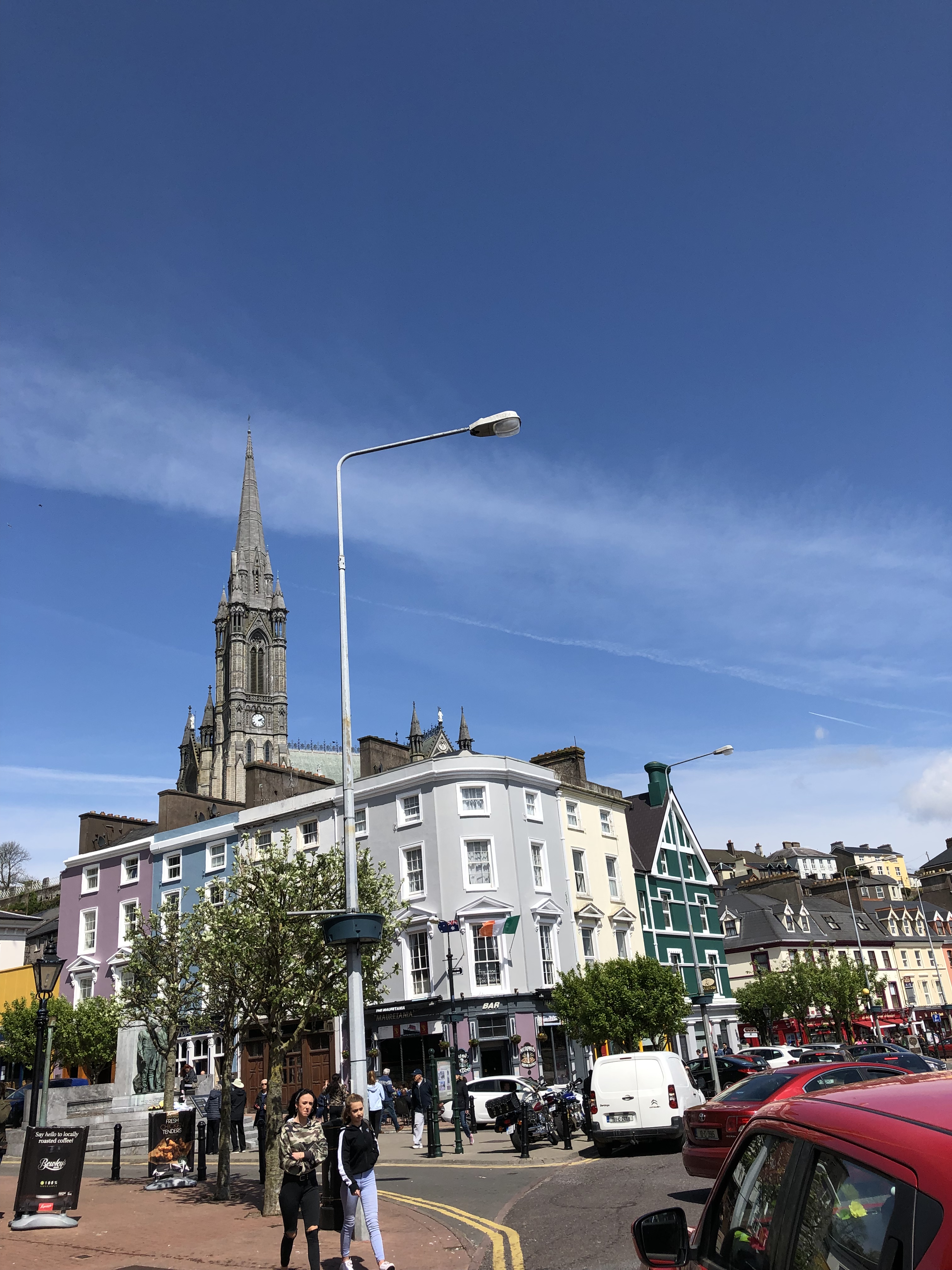
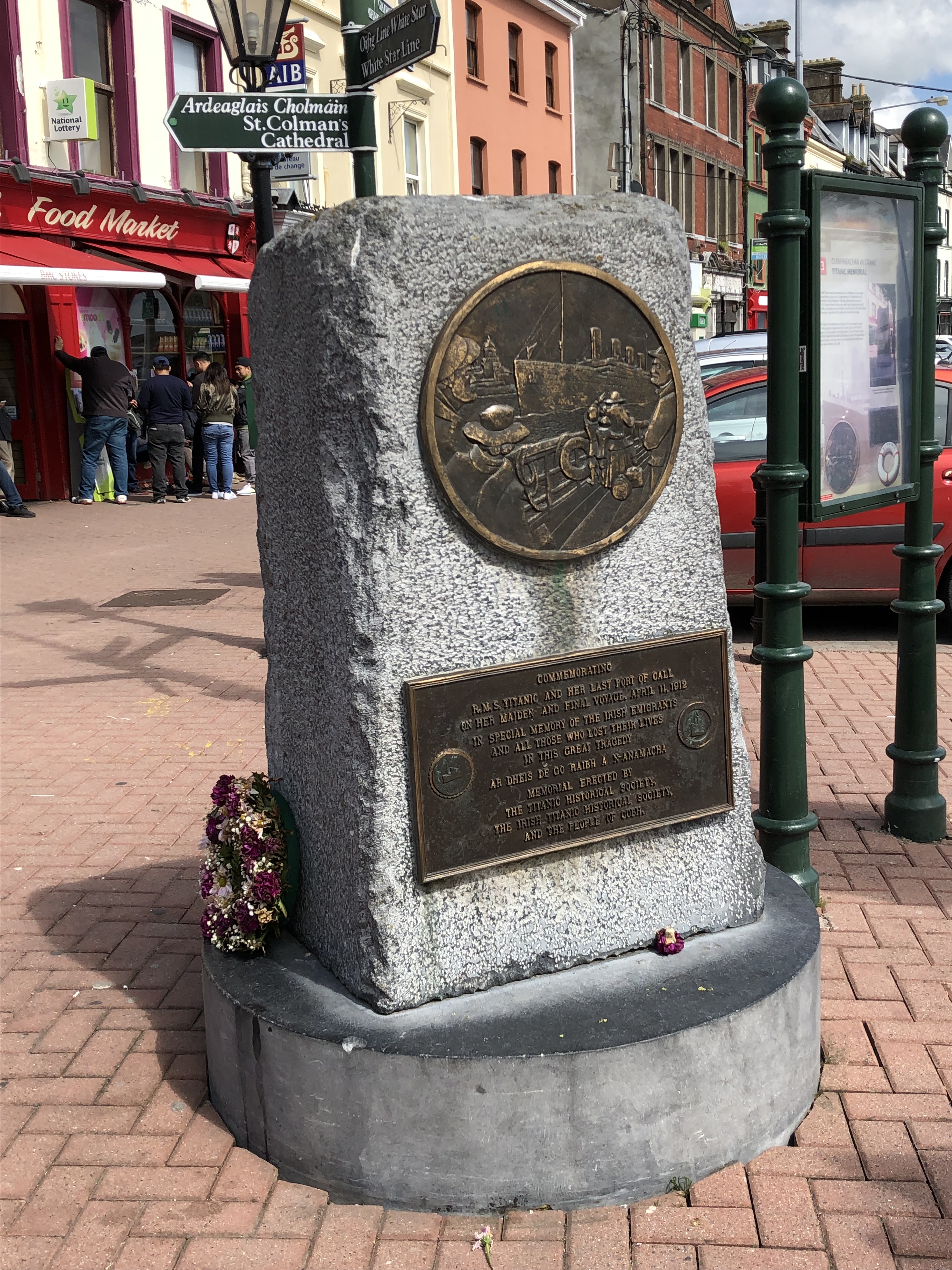
Today, we arrived in Ringaskiddy Port or Cork Port as it is sometimes called. Cork City is a few kilometers away and Cobh, the charming little town in the first photo is on an island across the Lee river from the port. All of the signs are written in both Irish and English and you move from one named area to another without realizing it, so it was sometimes hard to know where you were. This was the last port-of-call for the Titanic on April 11, 1912. The second photo shows a Titanic memorial in Cobh where 123 passengers bought their tickets and took tender boats out to the ship. We were led on our town tour by Dr. Michael Martin, a Titanic expert who told us a number of disturbing facts about how differently the first and third class passengers were treated.

The third photo shows a memorial to the fishermen of Cork who worked tirelessly to save 762 passengers on the Lusitania when it was sunk in 18 minutes by a German submarine. That event happened just a few nautical miles from Cork. Just over 1100 lives were lost. It struck me this afternoon that this might not be the best place to visit just before heading across the Atlantic!

We visited the Cobh Heritage Center after the town tour where numerous exhibitions told the stories of the nearly 3 million emigrants who passed through this port on their way to hopefully a better life in America and Australia. This began in the 1620’s and may very well have included some of my ancestors. This center also exhibited a number of stories about the Titanic and the Lusitania. One exhibit showed a bottle that a man from near Cobh threw from the Titanic with a goodbye note inside. It washed up a year later a few miles from his home. One more port and then I complete my circle.

Dublin, Ireland

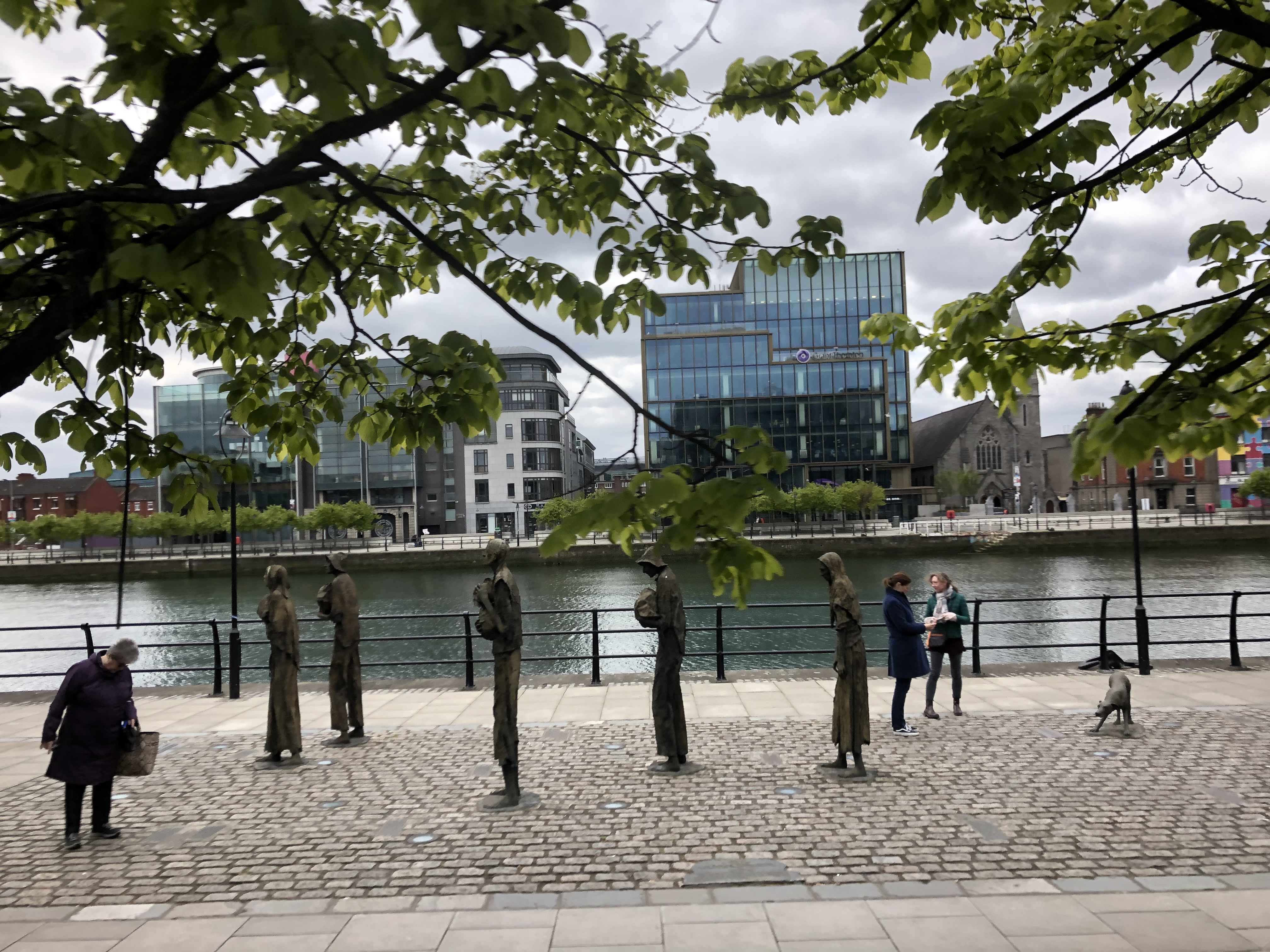
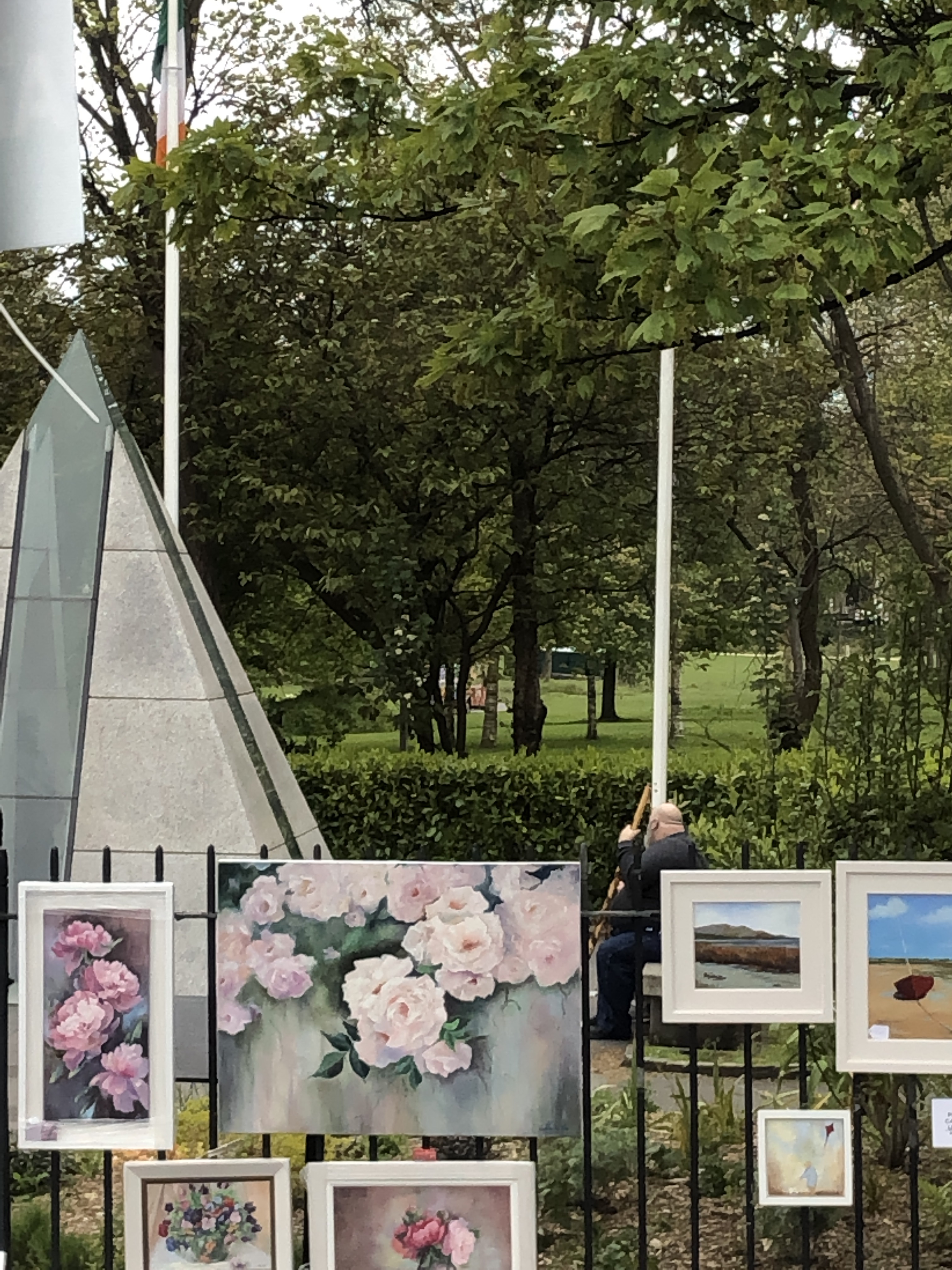
Yesterday, another beautiful day, we spent in Dublin. The first photos are from our bus tour of the city. Theviews along the Liffey River show a modern bridge, a sculpture memorial to the millions of Irish immigrants, and a model of the ship that made fourteen crossings without the loss of a single immigrant, emphasizing the dangers of leaving your homeland and the harshness of life that made them leave. We drove for miles past Phoenix Park. The fourth photo is a public part of the park with local artists showing their work outside. The fifth photo is the entrance to a part of the park that houses the US Embassy. The huge park also houses the home of the President of Ireland which looks very like the White House.

Our bus ride stopped at the GPO or general post office, where we experienced a vivid portrayal of how the Irish won their independence from The United Kingdom, beginning in 1916 with a week-long rebellion at the post office and ending with formation of the Republic of Ireland in 1922. Just up O’Connell Street we heard Irish folk tales and folk songs during lunch at the Old Music Shop.

From lunch we went to Trinity College for a tour of the campus and a visit to the old library where we saw two pages of the Book of Kells. Before seeing the book, we saw exhibits about how illuminated books were made. After seeing the book we saw the Long Room of the old library where books are filed according to size to protect the arches of the old building. I can’t imagine finding a particular book there, but the sight was impressive (shown below.)

The Book of Kells dates to around 750 AD and is a copy of the four gospels, done by four different scribes. The first and most celebrated page of the book is the Chi Rho page (shown below). Since I first saw one at the National Gallery in London, I have loved illuminated books, so this was a very special day.