Seville, Spain

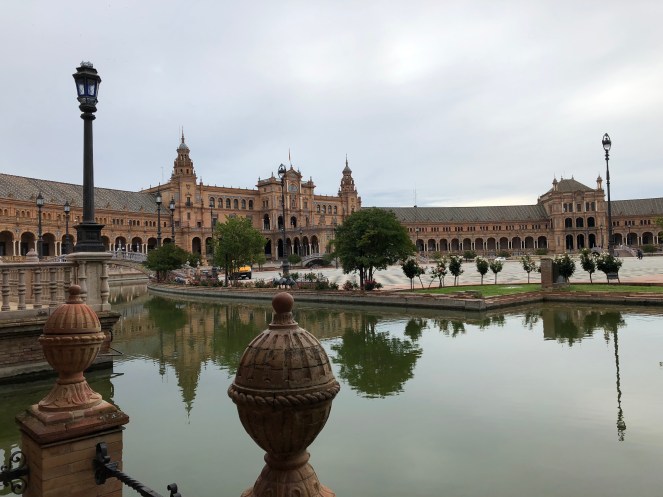
Today, we visited Seville. Wow, what a beautiful city. The first photo is the Plaza de Espana, the pavilion Spain built for the Iberian-American Exhibition of 1929, a world’s fair. On the way into the city from the port in Cadiz, we passed a number of buildings that American countries had built for the fair that now serve as embassies for some of those countries or other useful purposes. This beautiful Spanish building is now used for government offices. It was also the site of the filming of the Kingdom of Naboo scenes in one of the Star Wars movies. The second photo shows a seal, beautiful fresco, and map of Cadiz. One of these stations for each of the fifty-two counties in Spain is positioned around the facade.

Our next stop was the beautiful royal palace, called Alcazar. The third photo shows the inner courtyard that gave the palace light as there were no exterior windows for security. In one room we saw a model of the Santa Maria and Christopher Columbus’ crest on the wall. This is the room where Ferdinand and Isabella met with Columbus when he returned from discovering the new world. Alcazar goes back over a thousand years when the palace was built by the Arabs over earlier Roman structures, such as the wall. When the Christians took over from the Arabs, further changes were made. The palace embodies much of the history of Spain and is now a very busy museum.

We strolled through the old town and saw many narrow streets and courts with beautiful balconies. One is said to have inspired Rossini in writing the opera, The Barber of Seville. This stroll brought us to the Cathedral of Seville, the third largest cathedral in the world. There, they were preparing for an Easter Parade. This is definitely a place that warrants further visits.

Charity at Sea

Today is Good Friday and I thought I would tell you about something good. Holland America has done a number of charitable projects during the course of this Grand World Voyage. The first thing was the Walk for a Cause in which Holland America gave everyone a T-shirt for a donation to support cancer research and participation in a walk. Then, there was an auction of donated items that raised money for a children’s program in Mumbai. Examples of donated items were four nights in one of the suites, a private tour of the bridge, and water color painting done during the cruise.

Today was the big day for the Linus Project. The Linus Project is Holland America’s program of giving blankets to terminally ill children in Seattle, the company’s home base in the US. Orlando Ashford, the president of Holland America, and Captain Jonathan Mercer were present for a photograph with this year’s blankets and the people who produced them. When the trip is over, I will have crocheted two, the first of which is the yellow and gray sampler I am holding in the first photograph. The second photo shows my blanket in the midst of over two hundred others.

After communion at church this morning and the photograph with Mr Ashford and the blankets, I attended a lecture on the things that make diamonds rare and special if you are considering them as an investment. At the beginning of the lecture, Mr. Ashford gave an understated testimony to what he values, that being faith and family. No wonder Holland America does what it does and has such loyal employees.

Barcelona, Spain

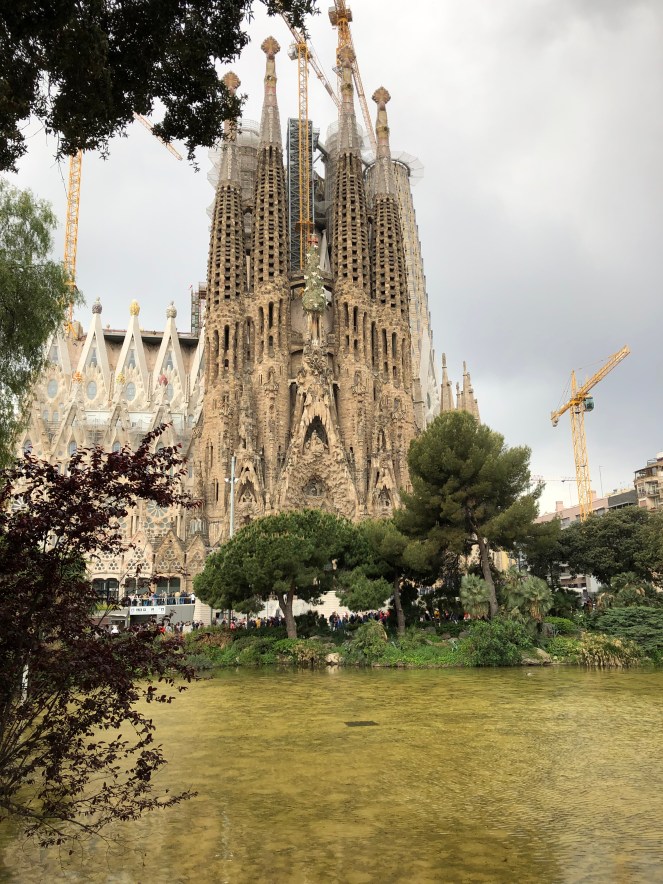
The first photo shows the famous Sagrada Familia, the basilica designed by Antoni Gaudi in honor of the Holy Family and the most visited site in Spain. Even with cranes in place for restoration, the view was stunning and photos fail to capture the awesome beauty. Every feature was chosen with a special meaning. Studying the detail of the exterior walls was like reading a Bible. The third photo shows the tower dedicated to the Easter story. With today being Maundy Thursday, the basilica was not open to the public.

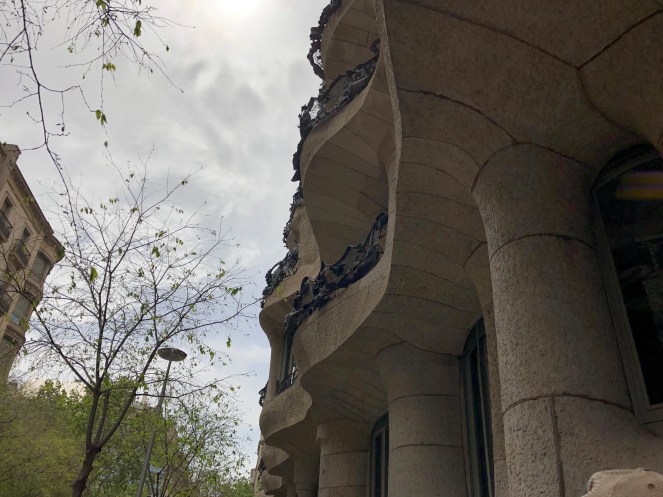
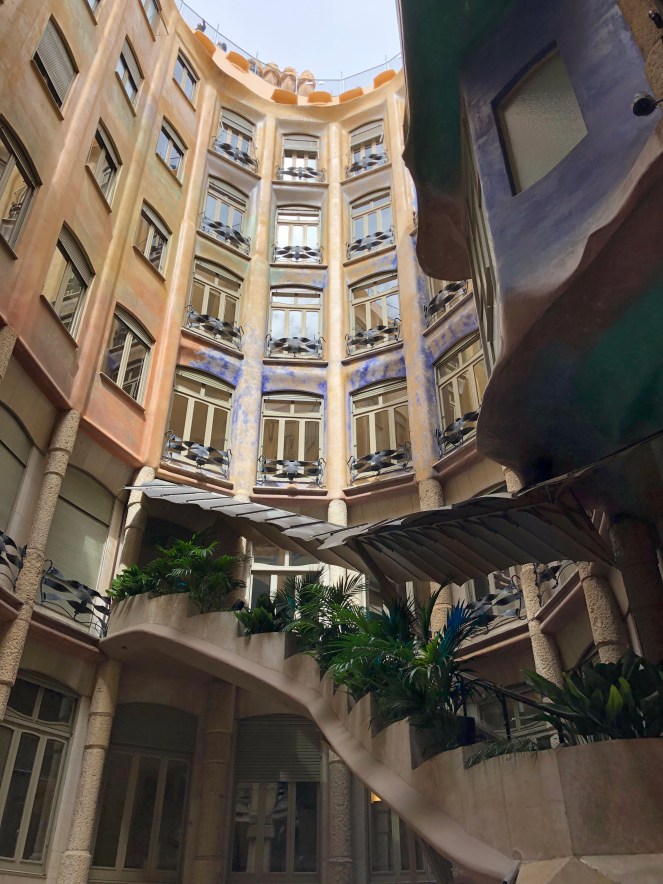
We did get to visit the interior of a house that Gaudi designed for Pere Mila, La Pedrera, built between 1906 and 1912. The fourth photo shows the exterior with its dramatic curves and unusual balconies. The final photo shows the interior courtyard which allows for the light from all sides in the apartments. The fifth photo shows the roof where we began our tour.The large round structure in the middle of the photo is one of six stairwells. The storm trouper-appearing structures are chimneys. Our guide said George Lucas visited this house and she thinks the storm troupers were inspired by these chimneys. Gaudi is said to have based his designs on things in nature, believing that God was the best designer. The interior of the house was filled with arches and windows that provided wonderful, natural light, unusual for the time. La Pedrera was declared a UNESCO World Heritage Site in 1984.

Barcelona is a beautiful city, even without the Gaudi structures. It dates from the first century BC. We saw remains of a Roman Wall at the back of the Bishop’s house, which was built in the 1200’s when the Cathedral was started. We also saw the venues built for the 1992 Olympics and still in use today. Our guide explained that the port can have cruise ships because it was enlarged to have cruise ships serve as hotel space during the Olympics. Apparently, Barcelona planned carefully for the Olympics. I am glad they did; it meant that Barcelona could be a stop on our Grand Voyage. I think this is a place that needs to be revisited.

Naples, Italy

Yesterday, we arrived in Naples, Italy. It seems a bit backwards, more like coming to fall after a hot, humid summer, but instead we came to a beautiful spring day with flowering trees from a hot, humid summer in the Southern Hemisphere and the heat of the tropics. Naples and Pompeii, where we spent most of the day, are overshadowed by the two-peaked, active volcano, Vesuvius. We learned that Vesuvius, which erupted and buried Pompeii in 79 AD, was a single-peaked volcano until that eruption when it collapsed its single peak and became two.

Pompeii is amazing. The whole of Pompeii, a walled city, has been identified and about one third of it has been excavated. This process began in the late 1700’s and continues to the present. We spent two hours exploring the wonders, Roman roads with pedestrian crossings, detailed drawings of mythical animals adorning the walls of the homes of the wealthy, pots along the streets that were used for early fast food, the theater, remains of columns, the Roman baths, and numerous altars. We could have easily spent eight hours. We saw only one of the thirty brothels. We saw a wealthy home which showed many details of their lives, but we missed the large frescoes that are often pictured in Pompeii. We saw many artifacts that were found in the city, including casts of some of the bodies, lying as they had been found, but the important artifacts are in a museum.

We had a fabulous Italian lunch at a hotel outside the gate to the ruins of Pompeii, after which we road around the Gulf of Naples to see the sights. We finished the day in the Piazza Plebiscito, Naples’ famous town square, where we saw the Royal Palace, the church of San Francesco from Paola, the oldest pub in Italy, the Gallery, the Theatre de San Carlo, and the “Rodeo Drive” of Naples. Tomorrow, we are in Barcelona and at the moment, we are passing between Corsica and Sardinia. I’m off for a photo that probably won’t upload.

Suez Canal

On Saturday, we crossed the Suez Canal from the Gulf of Suez into the Mediterranean Sea. It took most of the day as did the crossing of the Panama Canal. Like in Panama, there is a large lake between the narrow passages and there was an expansion in the early 2000’s. There the similarities end. The Suez Canal, built in the mid-1800’s, has no locks, is about twice as long and much more narrow than the Panama Canal, and could not be in a more different climate. The Suez Canal is in the desert and the Panama Canal is in tropical rain forest; no wonder the people who built the Suez Canal failed in Panama.

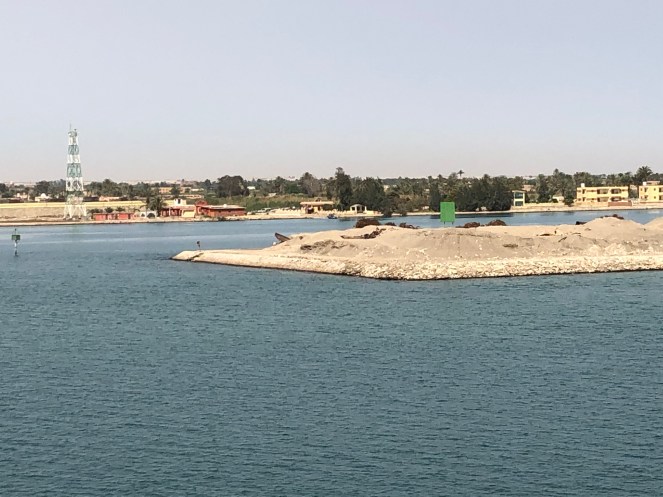
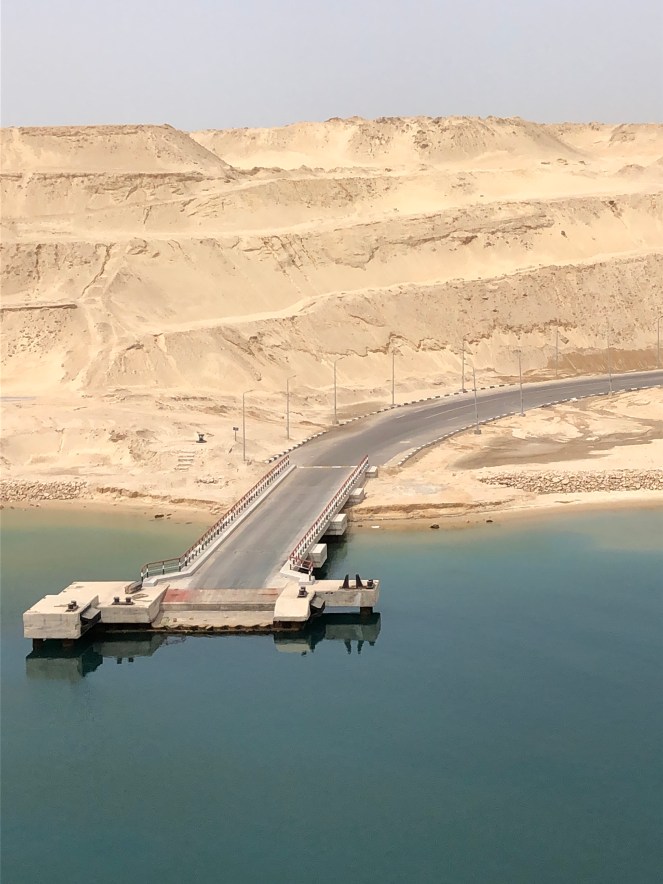
For a century and a half, the Suez Canal had one channel and ships traveled in convoys in one direction. A few years ago, an additional channel was added. The first photo shows the entrance into the first channel as we travel north in the new one. In the second photo to the left of my head, you can see a container ship in the other channel. The sand dunes in the middle hide the water in the other channel, making it look like that ship is traveling through sand.

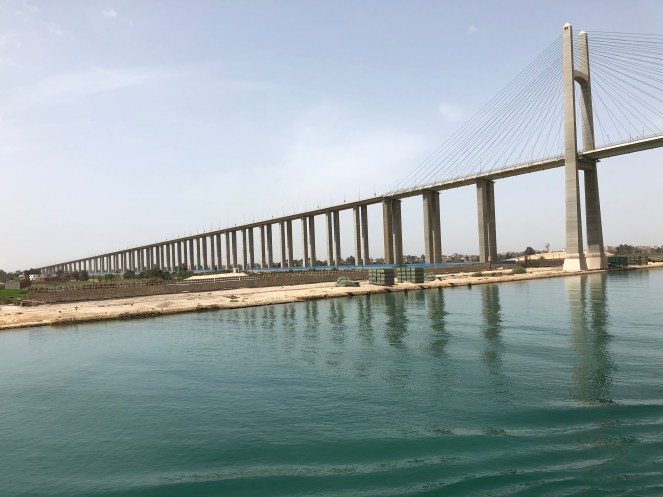
The third photo shows a swinging bridge that can be placed across the canal in a few minutes and allow passage from Egypt to the Sinai Peninsula (also Egypt) on the opposite side. Recently, a permanent bridge was built and a new city appears to be developing around it. More than one of our lecturers mentioned that in ancient times there were a number of other canals that connected various parts of the Red Sea to the Mediterranean, showing how important that connection was. As we travel northwest in the Mediterranean Sea, the temperature is much cooler and the sea more rough. We visit Naples tomorrow.

Petra, Jordan

Petra was built around 700 BC on the trade route from Mesopotamia to Egypt by a civilization called the Nabataeans. The city thrived even after it surrendered to Rome when the Romans learned how to cut off its secret water supply. In 363 AD a large earthquake destroyed much of the city. That combined with changes in trade routes caused the city to be abandoned by all but local Bedouins until it was rediscovered in 1812 by Johannes Burkhardt and became increasingly known to the West as The Red City due to the red color of the rocks.

A narrow gorge, The Siq, leads into the city. Along the gorge a number of rock carvings can be seen, including altars to their gods and remnants of the water channels that provided a secure water supply in this desert. The end of the gorge opens into the dramatic facade known as The Treasury, famed partly for its use in Indiana Jones and the Last Crusade as the location site of the Holy Grail. The Treasury and the other carved facades in Petra are actually thought to be monuments to the dead, though no remains have been found. According to our guide, Petra covers 40 square miles and only 5 percent of it has been excavated. No further excavation is being done.

Apart from the carved details in The Treasury, the rest of the city was disappointing to me. I could understand it being packed with people, but it was also full of people aggressively trying to sell you post cards, camel rides, and other tourist attractions. There were plenty of these outside the ticket gate. The horse cart drivers dangerously flew through the narrow gorge with people walking everywhere. I was shocked that UNESCO would allow such behavior in one of its world heritage sites. Perhaps, my expectations were too high; this was one of my top three places to see.

The bus ride to Petra followed The King’s Highway which is supposed to be the route followed by Moses in the desert. Along the way, we saw the mountain top where Aaron, Moses’ brother, is supposedly buried. The town surrounding Petra is called Wadi Mousa, the Arabic name for Moses. We drove for two hours in the desert. I can only imagine what it would have been like to wander here for forty years. Thank God for manna.

Fun at Wadi Rum, Jordan

Wadi in Arabic means valley. Yesterday, we bused past the movie set for the new Matrix movie into Wadi Rum, part of the Rift Valley in Jordan. Ariz, our 4X4 Bedouin driver, lived in a nearby village and spent his summers in a tent deeper in the desert. Twenty percent of Jordan’s people are Bedouin but more in this area, according to Aziz. We started at the Seven Pillars of Wisdom Mountain, the site where Lawrence of Arabia wrote his famed memoir.

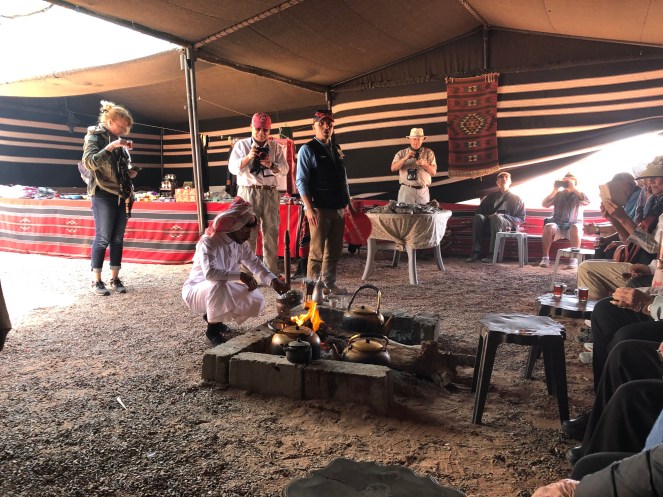
From the mountain we drove to a Bedouin tent for lunch. On the way we stopped at some 700 BC art on the rocks (the last photo). That stop also offered an optional camel ride (I didn’t) and served tea in a black-and-white-striped tent, which happened to have Bedouin goods for sale. I bought Drew a gift here. Another stop on the way was Lawrence’s Gorge. Here, an image of T. E. Lawrence was carved into stone as was an image of the first king, who served after Lawrence helped unite the Bedouin tribes.

At lunch we had a demonstration of a Bedouin oven. They dig a hole in the sand and burn wood to heat it. Then they leave just the embers, put in the food, and cover it with sand for a few hours. At the end of the demonstration, our food was dug out of the sand in a giant iron pot, lamb, chicken, and vegetables. Bowls of sides and drinks were brought in on a 4X4 truck. It was all delicious. Last night we watched Indian Jones and the Last Crusade, part of which was filmed in Petra where we go tomorrow.

Sunday at Sea

This Sunday, in the middle of five days at sea, has seemed the most like Sundays at home. It started with light breakfast, followed by church, a short time crocheting with the Sit and Knit group, then too much lunch at the Sunday brunch in the dining room. You get a set menu. First came the cold sampler, fruit salad shooter, mini Caesar salad, deviled egg with caviar, duck pate with blueberry compote on crouton, cream cheese with home-made gravlax, caprese on focaccia toast and shrimp nigiri with a pippete of soy.

Second came the main course, shown in the photo, a hot sampler with ham and cheese mini strata, seafood pot pie, biscuit with herbed gravy, mini mac and cheese, oven roasted lamb en croute, herbed potato confit, broccoli and carrot, and cinnamon swirl French toast with maple syrup. I could only sample some of each offering and I was still too full.

Finally came the dessert course, a mini walnut tart, chocolate panacotta, and berry mousse parfait. Since it is Sunday, I got to try the desserts. I have been foregoing dessert for Lent, more of a sacrifice here than it would be at home. After our daily Road Scholar lecture, Sandy and I finished the New York Times crossword puzzle, our eighth in a row, completed. When I finish this post I am going for a much needed walk. This evening the show on the Main Stage is Elliot Finkel, a pianist, and Helen Wilding, a soprano. As you can see, days at sea can be quite busy.

Pirates

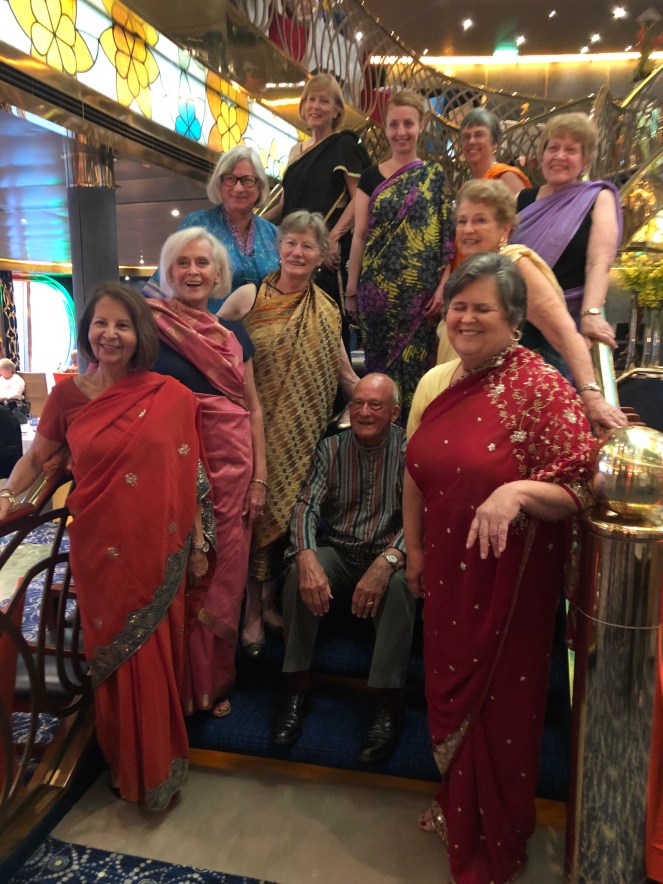
With all this glitter from sari night, one might think that cruise ships would be pirates’ first choice of victims, but cargo ships and oil tankers have that honor. They have valuable loot and they move slower. Early in the twenty-first century, piracy off the coast of Somalia became a real problem with at least one cruise ship boarded. Wilbur Smith, one of my favorite authors wrote a wonderful adventure story about it, so when I saw that we would be passing near the coast of Somalia, piracy crossed my mind. I did not think of it again until we left India four nights ago and our daily schedule said that there would be an anti-piracy drill the next morning.

Captain Jonathan made an announcement that he had notified the Maritime Authority of our entrance into that part of the Indian Ocean, which meant that Maritime Patrol vessels would be accompanying us. During the drill, all passengers were to go to an inside area away from windows and sit down. Sitting was required so the captain could maneuver the ship without us falling. The maneuvers were speeding up and turning quickly. Guest services would stop as crew did their assigned tasks. Our room steward visited each stateroom and put an evacuated sign in the door. Armed guards were assigned to sit about the ship with binoculars to sight threats. The crew placed high pressure water hoses on the deck to use against anyone trying to board. Razor wire was made available to put around deck three should it be required. Finally, all window curtains are too be closed from sunset to sunlight to make us less visible.

Captain Jonathan assured us there is very little risk, but they need to stay prepared. He, proudly, said we could do twenty-five knots. Apparently, that is faster than the pirate boats. Lest you worry, I researched the issue a bit on the internet and it turns out that since 2011 when they began the patrols, the problem has significantly reduced. As I write we are heading to the riskiest area; we are out of the risky area after April 9. Please, those of you who are praying for me, keep it up and thank you.

Muscat, Oman

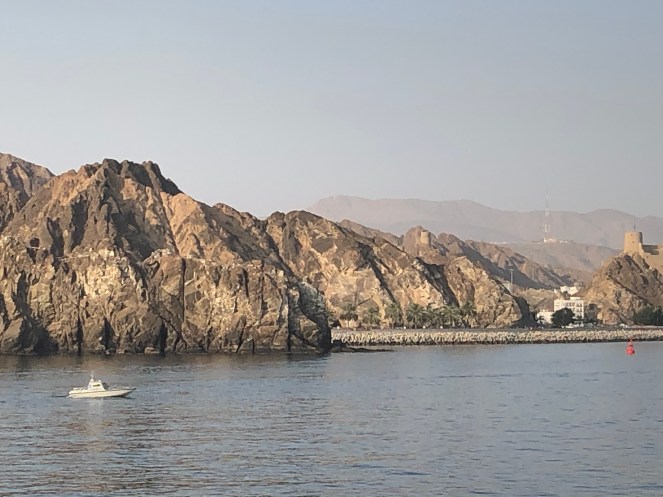
We spent today visiting Muscat, the capital of Oman. This photo, taken as we came into port, shows the arid, rugged mountains that cover the coast of Oman, making it the most alien-looking place I have ever visited. I have seen the desert in Arizona, but I had never seen desert mountains. Rarely, a brown bush grew on the mountains, which were background to almost every landscape and completely surrounded the city. Oman is a sultanate, meaning the sultan is the hereditary leader. The current sultan, Qaboos, came to power in 1970 when he ousted his father for wanting to keep things as they had always been. Consequently, the city is filled with modern buildings, all less than fifty years old. This sultan is greatly loved and appears to have done a lot for his people.

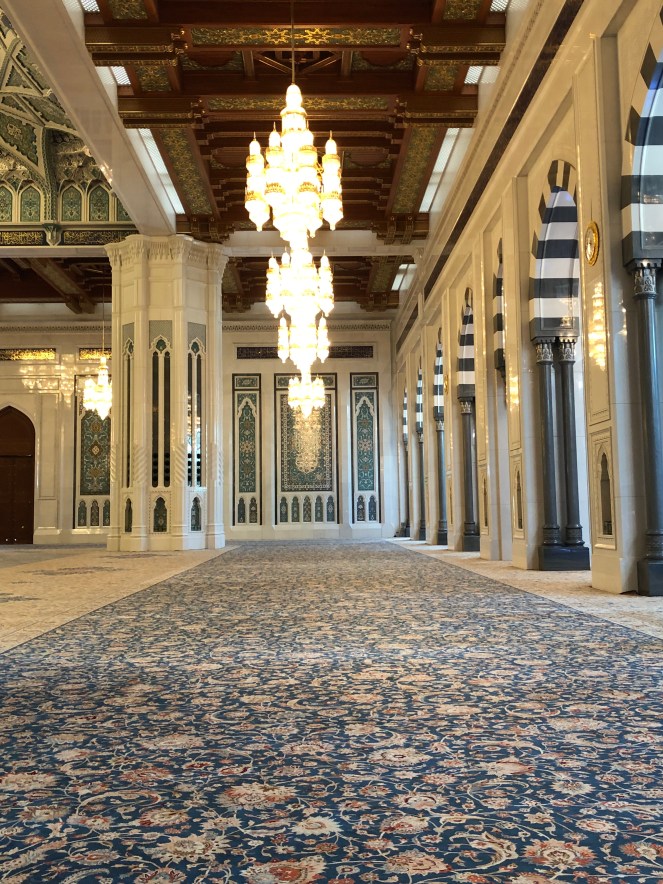
Our first stop was at The Grand Mosque. I nearly suffocated in the long sleeves, long pants, and scarf the women were required to wear. Still, it was beautiful with no expense spared. The chandelier in the men’s prayer hall, shown in the photo, is made of solid gold and crystal. According to our guide, it is the most valuable chandelier in the world. The carpet was hand woven in traditional Muslim colors and is the largest single carpet in the world. The prayer hall will accommodate over 6000 men. The more modest women’s prayer hall only accommodates a few hundred. When we asked the guide why there were so few places for women, he said that they were expected to pray at home. From the mosque we visited the Muttrah Souq. Souq means market and this one was so crowded and so full of merchandise that many of us were overwhelmed. They take any kind of money as well as credit cards. From there we visited a small museum with a collection of weaponry, jewelry, and currency. From there we stopped for a photo moment at Sultan Qaboos’ palace (the third photo). We finished with lunch and yet another museum.

Outside the museum there were multiple goat-like figures, brightly painted and all different. I asked the guide about them and he explained that these were Arabian oryxes painted by local artists for a recent festival. It was like Chicago did the cows, Cincinnati the pigs, and Lexington the horses. That was one familiar thing in a very foreign place.