What a Day at Sea!

Today I feel so blessed. After a bowl of fabulous oatmeal with hot milk and blueberries, I went to beginning bridge class. It is an excellent class and I am working at a table with Phil, Judy, and Luci, delightful people. Phil and Judy are from Wisconsin and met each other 8 years ago on a bus in Poland. After bridge, I went to a class about the essentials of Windows 10. The teacher is excellent, and I plan to do more of her classes. From that I was on to a trivia session where I saw beautiful photos of some of the places we will visit.

After a quick lunch of Indonesian chicken noodle soup and frozen yogurt, I was on to my Road Scholar class on igneous rocks. From that I had a class on making gift boxes. Then, I was on to perhaps the most exciting part of the day; I signed up to be part of the Holland America Line Chorale. We will be a chorus of about fifty that will rehearse every other day at sea and perform in a show at the end of the cruise. I am so excited to be able to sing. I confess that missing choir was one of the chief things I had against doing this trip.

Every passenger who does the whole world cruise is invited for one dinner with the captain in the private restaurant, The Pinnacle Grill. Tonight was our night. We were asked to wear elegant dresses and had our photograph taken with the captain on entrance. Sandy and I were seated at a table of three. The staff person assigned to our table was Terry, the head of Security. We had fabulous conversation, an unbelievable meal, and a gift of appetizer plates commemorating Holland America ships. From dinner we rushed to the evening show, which was pianist, Tim Abel. He was fabulous. As a matter of fact, I think the shows on this trip are the best I have heard on any cruise ship. I had hoped to add photos, but the internet this far out to sea is slow and a bit unreliable. So, picture me smiling.
The Year of the Pig

Happy New Year; that is happy Chinese New Year. Today is the lunar New Year which is celebrated all over Asia, not just China. At breakfast this morning the servers taught me how to say happy new year in three different Asian languages. “Kung Hei Fat Choi” is Cantonese. “Selamat Tahun Baru” is Indonesian. “Megan Dang Umaga” is from the Philippines.

The Chinese zodiac has twelve animal signs depending on the lunar calendar and your birth year. This is the year of the pig. Each animal has certain personality traits. Sandy and I are both pigs as are seven of our forty-seven Road Scholar group. Perhaps, that is why we chose 2019 for this grand voyage. Regardless, Road Scholar gave each of us a little pink pig. I photographed mine with the Pacific Ocean in the background but it failed to upload.

The Lido deck, where we have our informal meals mostly lunch and breakfast, was decorated for the occasion. This evening a special Chinese dinner was planned. I ate in the dining room because I am spoiled by the service, but I did have Chinese food in honor of the holiday. The show, a magician/illusionist, was excellent as they all have been though he had nothing to do with New Years or pigs.

Arica, Chile

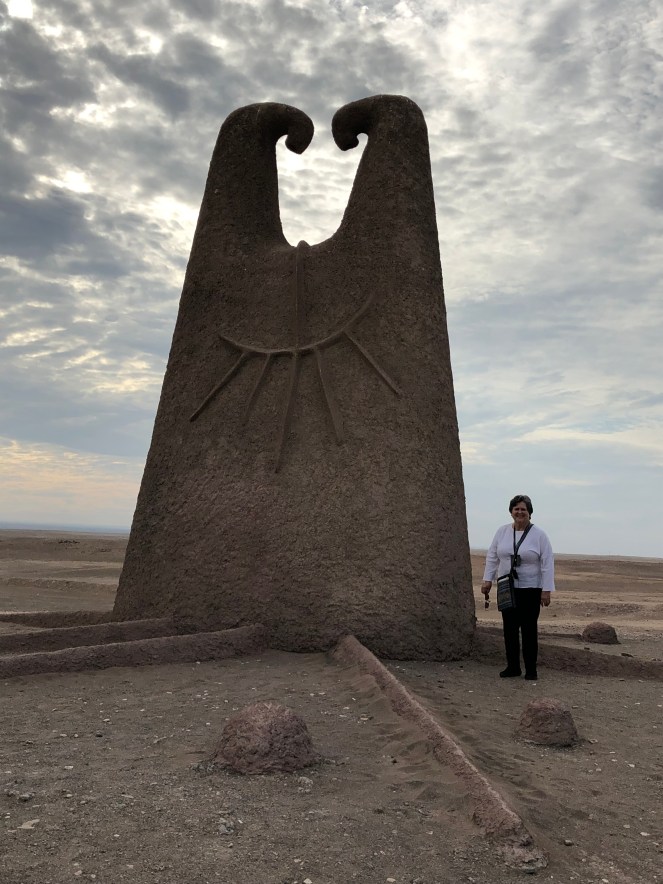
After a late night watching the Super Bowl in the Main Stage, complete with snacks appropriate to New England and L. A., the clocks moved forward two hours, making it even harder to get up for this morning’s tours; they were worth it. Arica is located in the Atacama Desert, which runs along the coast in southern Peru and northern Chile. As you can see from the background of the first photos, the landscape is brown and barren. A local university professor, named Juan Diaz Fleming conceived of a public art installation to make the desert more interesting. I love the name; translated into English, it is the Garden of Presence.

The first photo shows me standing next to one of the concrete sculptures Fleming created. This one represents Pacha Mama, the Chilean name for a goddess who is like earth mother. It is supposed to be a uterus with Fallopian tubes at the top. The orthopedic surgeon in our group thought as an OB/GYN I should be photographed with her! The next photo is a sundial. The last two represent a man and a woman. Chilean dancers in native festival costumes are seen with the sculpture representing man.

A few years ago as the water company dug a sewer line, they discovered mummies. An archeological site was declared. Multiple bodies and artifacts have been found and are exhibited in the museum we visited next. Carbon dating showed these bodies to be over 7000 years old. The Chinchorro and their culture from 5000 B.C. are well represented. This makes me question the theories about people from North and South America coming over a land bridge in Alaska!

Lima, Peru

Last night I was too exhausted to write about the day. We arrived in Callao, Peru, the largest port on the western side of South America, at 10:00 AM yesterday morning. Our cruise ship was surrounded by cargo ships with many more anchored out to sea. We assumed they were waiting to be loaded. The empty one next to us was loaded all day yesterday and pulled out this morning. This large shipping center is one of the few ports where we stay overnight. We are probably loading lots of things before we leave this evening. I am playing hooky from Road Scholar’s trip today. They are going swimming with the sea lions, and I don’t swim that well.

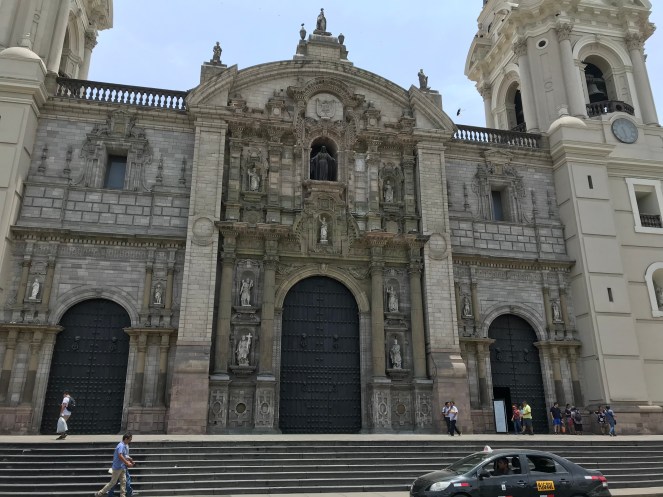
Yesterday, we took a 40 minute trip into the capital city, Lima. All these SouthAmerican cities seem to have a town square. Lima’s was beautiful with the cathedral on one side, the presidential palace on the right side, and two restored examples of colonial architecture on the other two sides. Inside the cathedral we visited the tomb of Pizarro. Our guide seemed to have mixed emotions about memorializing the conquistador. After a walk through the old town, we had a typical Peruvian lunch with potatoes cooked three different days. Apparently, they have over a hundred varieties of potatoes!

In the afternoon we visited the catacombs of a Franciscan church. I have posted the photo of the outside, but photos were not permitted inside. Suffice it to say we saw a lot of ancient human bones, at least the large, sturdy ones. They used to bury the poor people for a few years. Then they took them up and put the remaining bones in deep wells that had been dug to help protect the church from earthquakes. The guide explained that most of the structures had suffered damage from earthquakes and what we saw were restorations. Back at the port we saw some beautiful alpaca wool articles for sale by vendors who sat up tents on the docks. Tomorrow is a day at sea. I understand we get the Super Bowl on the main stage.

Trujillo, Peru

Today began early when a beeping outside signaled our arrival in Trujillo, Peru at 3:26 this morning. I thought the beeping was my alarm clock, but I had two more hours of sleep before we prepared for the day’s adventures. First we visited a beautiful town square with excellent examples of colonial architecture, confirmed by the balconies and windows. A museum in one of the buildings on the square allowed us to see inside the colonial buildings for the first time. Typically they have several courtyards. In this particular one, we saw a room where Simon Bolivar had stayed on a visit to Peru. We saw samples of the first Peruvian paper currency which was made in Peru but used American paper.

After the colonial museum, we visted an archeological museum that had examples of artifacts from ancient indigenous people including the Moches (early Chimu’) from around 700 AD and the Chimu’s from 900 AD to 1463 when they were invaded by the Incas.

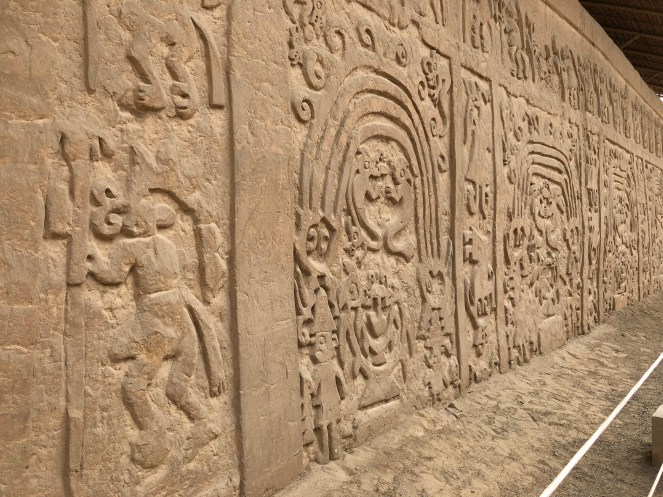
After a delicious lunch with a fish dish that tasted exactly like grouper fingers from Merrick Inn in Lexington, Kentucky, we visited a UNESCO world heritage site called Chan Chan. It reveals more of the way the Chimu’ people lived. The Chimu’ worshipped the moon and like the Incas, they practiced human sacrifice when they believed the gods needed to be appeased, such as after tsunamis or earthquakes.

Panama City Architecture

The pope visited Panama City last week and left the day before we arrived yesterday. Unfortunately the thousands of people who came from all over the world to see him did not leave with him. Yesterday, they all went to see the same sights as the two cruise ships’ passengers, the Miraflores Locks museum and the old city. Because of the shoulder to shoulder crowds, I left the museum and went outside to watch the ships passing through the locks. There, it was sunny and 89 degrees.

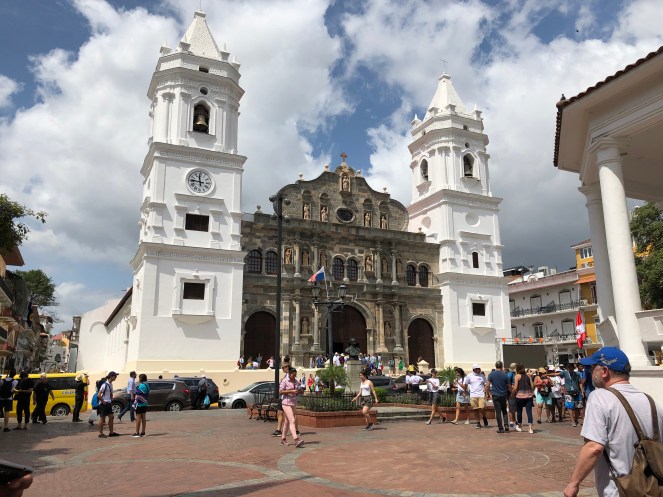
Panama City was established in 1519 by Spaniards on the Pacific side of Panama. In the late 1500’s pirates came down the Chagas River from the Caribbean and destroyed the town, which was rebuilt in the 1600’s. In the old town we walked past ruins and examples of colonial architecture which is very different from the modern city seen from the starboard side of the ship.

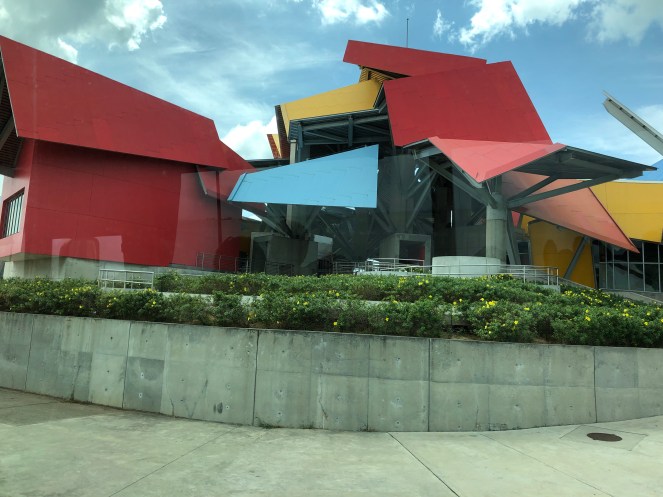
On our way back to the pier we passed the Frank Gehry building shown in the last photo. It is used as a biological research center. Today, I’ve had a walk and morning stretch. Now, I’m off to breakfast followed by beginning bridge class, two lectures, lunch, another lecture, bingo, a gala dinner followed by the evening show, and a masked ball. So ends what some would call a boring day at sea.

Panama Canal

This photo of the third step of the Gatan Locks on the Caribbean side of the Panama Canal shows the two channels in the locks, the bow of our ship in the right, a container ship in the left, and Gatan Lake beyond. Today’s transit of the canal was very different from what I experienced thirty years ago. Today, I had read The Path Between the Seas and knew what I wanted to see; the ship brought on board a canal expert that explained things as we passed, and we were given a certificate authenticating our passage.

Thirty years ago, I remember foolishly thinking how convenient it was that Lake Gatan was there to provide over half the length of the canal. I didn’t know that Lake Gatan was made by damming the Chagas River near the Gatan Locks. Fifteen villages had to be relocated, but this solved the problem of the Chagas River flooding during the rainy season, a problem that had stymied the French when they were trying to build the canal. I especially wanted to see the Culebra Cut. This is a mountain that had to have a nine mile, twenty-five-story-deep channel cut through it. Earth from this cut was moved by rail to build the earthen dam that created the lake. It all is an engineering marvel, especially considering it was completed in 1914. About nine hours after we entered the Gatan Locks, were exited through the two locks on the Pacific side, the Pedro Miguel and the Miraflores.

Once we were through the first set of locks and into the lake, I went to a lovely chapel service which began with singing Great is Thy Faithfulness, followed by the Apostle’s Creed. I felt right at home. The homily was based on John 20:19 which says that the disciples had the doors locked because they were afraid of the Jews, but Jesus entered and said “Peace be with you.” I leave you with His words.

Molas from the San Blas Islands

The San Blas Islands are an archipelago of 378 tiny islands, only 50 of which are populated by an indigenous tribe called Guna or Kuna. The islands are part of the Republic of Panama and located northwest of the isthmus. This first photo off the starboard side of the ship shows how small even the populated islands are and how far we have to travel in the ship’s life boats in order to visit. While it did not rain on us, as you can see, the day was cloudy.

The Guna are famous for making molas such as the one in this photo. An important part of their identity and economy, these colorful creations are made by a process of applique’ and reverse applique’ on multiple layers of cotton fabric. They are then added to clothing and worn everyday or to celebrate special occasions.

Tomorrow we cross the Panama Canal and dock in Panama City. In preparation for this I read The Path Between the Seas by David McCullough. I highly recommend that book for anyone interested in the most significant engineering feat of the twentieth century.

Santa Marta, Colombia

Santa Marta, Colombia, the oldest city in Colombia established in 1525, appeared like this at 8:00 this morning off the starboard side of the ship. We crossed the gangplank and stepped ashore for the first time in three days. After an hour’s drive between the Tairona National Park on one side of the road and the Sierra Nevada de Santa Marta mountains on the other, we arrived at an archeological site in the mountains which had been a Tairona village. The Tairona were an indigenous tribe that prospered from 900 AD to 1500 AD when the Spanish arrived. The Kogi tribe are descendants of the Tairona and still live in the area.

Following a short boat ride, we visited a typical Kogi hut, made of sugar cane husks and a thatched roof. A fire burned in the center of the round space, about 20 feet in diameter. Men and women enter from opposite sides, not unlike Shakertown. Two hammocks were hanging on opposite sides of the space for sleeping. A Kogi man sat in front of the fire and crushed seashells in a poporo, which is a hollow gourd with a long neck given to young boys at puberty. As he created a white lime powder, he chewed coca leaves. Our guide explained that the lime mixed with saliva and coca leaves creates a “numbness” that strengthens the men when they have hard tasks to do, have to go without food, or want spiritual experiences. The guide said it is not like cocaine, but it sounds like it is to me. Cocaine is processed from these leaves.

A very small museum had examples of Tairona weapons which were bows and arrows and large round stones that were thrown from heights to break the legs of the Spanish horses. Many examples of burial vessels varied in size based on the importance of the person and were decorated on the outside to indicate the sex of the remains. Paintings depicted battles with the Spanish, especially the last battle before the women, children, and old men disappeared into the mountains. Following a typical Colombian lunch, we returned to Santa Marta for a short walk through the city to visit Simon Bolivar park and the cathedral where he laid in state before his remains were returned to Venezuela. We boarded the ship after a full day with five minutes to spare before departure.

The Ship’s Crew

For me this day at sea aboard the MS Amsterdam began with a big smile from Doreen or Doreen with the red lips as she introduced herself. As she made my smoked salmon omelette, she asked my name and I am betting that she will remember it at breakfast, if not tomorrow, then certainly by the end of this trip. I intend to remember her and her beautiful smile.

As I sat down with my food, another big smile greeted me. This time it was Ghilbert who wanted to know my name as he served coffee. Like Doreen and many of the crew, Ghilbert is from the Philippines and has signed a nine or ten month contract with Holland America. Ghilbert’s fifth contract is as a waiter. His first four were to wash dishes. He says he likes working as a waiter better than washing dishes. That smile would be wasted on dirty dishes.

Throughout the day, I observed the crew. They smiled, were kind, and always offered a greeting or some service. Wan and Mabe, our cabin stewards, are equally kind and helpful. I hope never to take any of them for granted and to let them know how much I appreciate them. Tomorrow we reach our first port of call, Santa Marta, Colombia.